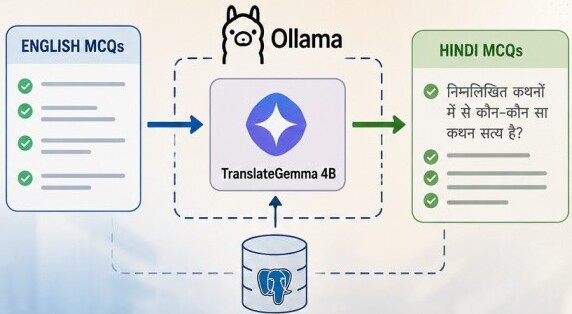
The solution uses Ollama as the local LLM runtime, TranslateGemma 4B as the primary translation model, and Python as the orchestration layer.
The approach also evaluates two different models: Qwen3 4B and TranslateGemma 4B.
1. Problem Statement
The application already contains approximately 12,000 multiple-choice questions (MCQs) stored in PostgreSQL. Each MCQ consists of a question, four options, the correct answer, and an explanation.A typical record looks like this:
{
  "question": "Which of the following statements are true about India?\n

\n1. India is the fifth largest country in the world.
\n2. It occupies about 2.4 percent of the total area of the lithosphere.
\n3. Whole of India lies in the torrid zone.
\n4. 82°30' East Meridian and hemisphere is used to determine Indian Standard Time",
  "optionA": "1 and 2",
  "optionB": "2 and 3",
  "optionC": "1 and 3",
  "optionD": "2 and 4",
  "explanation": "India's total geographical area is approximately 3.28 million square kilometers, which accounts for about 2.4% of the world's total geographical area.\n

\nThe 82°30' E longitude is the Standard Meridian of India, which passes through the center of the country and is used as the reference meridian for Indian Standard Time (IST).\n

\nIndia is the seventh-largest country in the world by area. The countries larger than India are Russia, Canada, China, the United States, Brazil, and Australia.\n

\nThe Tropic of Cancer (23°30' N latitude) passes through the middle of the country, dividing it into almost two equal parts. The area south of the Tropic of Cancer lies in the torrid (tropical) zone, while the area north of it lies in the temperate (subtropical) zone.",
  "answer": "D",
  "quiz": {
    "name": "India: Area, Latitude, Tropic of Cancer & Borders",
    "subCategory": {
      "name": "Indian Geography",
      "category": {
        "name": "General Studies (GS) PYQs"
      }
    }
  },
  "tags": [
    "Indian Geography"
  ],
  "uniqueCode": "X1y0ljrNx",
  "slug": "which-of-the-following-statements-are-true-about-india-br"
}Why local LLM?
When an application contains thousands of educational questions, translating them manually is expensive and difficult to maintain.
Sending every question to a commercial LLM API such as ChatGPT or Gemini can also become expensive when the dataset contains thousands of questions, options, and detailed explanations.
A better approach for a large batch-translation workload is to run an open translation model locally.
The model runs on the developer's own machine, the English content remains local, and the translation cost is effectively zero after the initial setup.
Ollama is a tool that lets you run open-source LLMs locally on your computer, without sending prompts to a cloud AI service.
It provides a simple CLI and a local REST API, typically available at http://localhost:11434. Install Ollama — current macOS version requires macOS 14 Sonoma or later.Start Ollama:brew install ollamaOLLAMA_NUM_PARALLEL=4 ollama serve
2. Model Candidates
I tried two models during the evaluation.The first was Qwen3 4B. Qwen3 is a general-purpose multilingual LLM rather than a model dedicated exclusively to translation.
The Q4_K_M version used in the experiment is approximately 3.5 GB and can run locally through Ollama. Ollama exposes Qwen3's thinking capability, which can be disabled through the API using "think": false.
The second model was TranslateGemma 4B. It is specifically designed for translation and is based on Gemma 3.
The Ollama distribution provides 4B, 12B, and 27B variants, with the 4B version approximately 3.3 GB. TranslateGemma supports translation across 55 languages and has a specific prompt format intended for translation tasks.
2.1 Qwen3 4B Experiment
The first experiment used Qwen3 4B through Ollama. The model was installed using:ollama pull qwen3:4b-q4_K_Mollama run qwen3:4b-q4_K_M% ollama ps
NAME ID SIZE PROCESSOR CONTEXT UNTIL
qwen3:4b-q4_K_M 2bfd38a7daaf 3.3 GB 100% GPU 4096 4 minutes from now
request-qwen.json
{
  "model": "qwen3:4b-q4_K_M",
  "messages": [
    {
      "role": "user",
      "content": "You are a professional English (en) to Hindi (hi) translator. Translate the following MCQ into standard, natural Hindi suitable for Indian competitive-exam questions.\n\nRules:\n1. Return ONLY the Hindi translation.\n2. Do not add explanations, commentary, markdown, or code fences.\n3. Preserve all HTML tags exactly, including , , and
.\n4. Preserve numbers, dates, percentages, degrees, coordinates, symbols, and units.\n5. Use commonly accepted Hindi names for Indian places, geographical terms, historical terms, institutions, and technical terminology.\n6. Do not mechanically transliterate English words when an established Hindi term exists.\n7. Do not change the factual meaning.\n8. Translate the question, optionA, optionB, optionC, optionD, and explanation.\n\nQuestion:\nWhich of the following statements are true about India?\n

\n1. India is the fifth largest country in the world.\n2. It occupies about 2.4 percent of the total area of the lithosphere.\n3. Whole of India lies in the torrid zone.\n4. 82°30' East Meridian and hemisphere is used to determine Indian Standard Time\n\nOption A:\n1 and 2\n\nOption B:\n2 and 3\n\nOption C:\n1 and 3\n\nOption D:\n2 and 4\n\nExplanation:\nIndia's total geographical area is approximately 3.28 million square kilometers, which accounts for about 2.4% of the world's total geographical area.\n

\nThe 82°30' E longitude is the Standard Meridian of India, which passes through the center of the country and is used as the reference meridian for Indian Standard Time (IST).\n

\nIndia is the seventh-largest country in the world by area. The countries larger than India are Russia, Canada, China, the United States, Brazil, and Australia.\n

\nThe Tropic of Cancer (23°30' N latitude) passes through the middle of the country, dividing it into almost two equal parts. The area south of the Tropic of Cancer lies in the torrid (tropical) zone, while the area north of it lies in the temperate (subtropical) zone."
    }
  ],
  "think": false,
  "stream": false
}
curl http://localhost:11434/api/chat \
-H "Content-Type: application/json" \
-d @request-qwen.json \
-o response-qwen.json % Total % Received % Xferd Average Speed Time Time Time Current
Dload Upload Total Spent Left Speed
100 5263 0 3063 100 2200 89 64 0:00:34 0:00:34 --:--:-- 786response-qwen.json
{
  "model": "qwen3:4b-q4_K_M",
  "created_at": "2026-08-11T16:58:21.816271Z",
  "message": {
    "role": "assistant",
    "content": "अंतर्राष्ट्रीय घटनाओं के बारे में निम्नलिखित कथनों में से कौन-सा सत्य है?\n

\n1. भारत विश्व के पांचवे सबसे बड़ा देश है।\n2. यह पृथ्वी के कुल क्षेत्रफल के लिथोस्फीरे के लगभग 2.4 प्रतिशत का आंकड़ा देता है।\n3. भारत के पूरे क्षेत्र शारीरिक जोन में रहता है।\n4. 82°30' पूर्व अक्षांश और आधिकारिक अर्धगोलार्द्ध भारतीय समय के निर्धारण के लिए उपयोग किया जाता है\n\nविकल्प A:\n1 और 2\n\nविकल्प B:\n2 और 3\n\nविकल्प C:\n1 और 3\n\nविकल्प D:\n2 और 4\n\nस्पष्टीकरण:\nभारत के कुल भूगोलीय क्षेत्र लगभग 3.28 मिलियन वर्ग किलोमीटर है, जो विश्व के कुल भूगोलीय क्षेत्र के लगभग 2.4% का आंकड़ा देता है।\n

\n82°30' E अक्षांश भारत का सामान्य अक्षांश है, जो देश के केंद्र में गुजरता है और भारतीय समय (IST) के लिए संदर्भ अक्षांश के रूप में उपयोग किया जाता है।\n

\nभारत विश्व में भूगोलीय क्षेत्र के आधार पर सातवें सबसे बड़ा देश है। भारत के बड़े देश इसके अतिरिक्त रूस, कैनाडा, चीन, अमेरिका, ब्राजील और ऑस्ट्रेलिया हैं।\n

\nकैंसर विपत्ति (23°30' उत्तर अक्षांश) देश के केंद्र में गुजरता है, जो देश को लगभग दो बराबर भागों में विभाजित करता है। कैंसर विपत्ति के दक्षिण में स्थित क्षेत्र शारीरिक (तापमान) जोन में रहता है, जबकि इसके उत्तर में स्थित क्षेत्र शीत जोन (सबट्रोपिक) में रहता है।"
  },
  "done": true,
  "done_reason": "stop",
  "total_duration": 36274259750,
  "load_duration": 186300625,
  "prompt_eval_count": 515,
  "prompt_eval_duration": 54102000,
  "eval_count": 1071,
  "eval_duration": 35877791000
}Qwen3 therefore worked technically, but the experiment showed that a general-purpose LLM was not necessarily the best choice for a large-scale English-to-Hindi translation workload.
2.2 TranslateGemma 4B
The second model was TranslateGemma 4B.This model was immediately more interesting because it is specifically designed for translation while still being small enough to run locally through Ollama.
The official Ollama distribution lists the 4B version at approximately 3.0 GB and supports 55 languages.
Installation is extremely simple:
ollama pull translategemma:4bollama run translategemma:4b% ollama ps
NAME ID SIZE PROCESSOR CONTEXT UNTIL
translategemma:4b c49d986b0764 2.9 GB 100% GPU 4096 3 minutes from now
request-translategemma.json
{
  "model": "translategemma:4b",
  "messages": [
    {
      "role": "user",
      "content": "You are a professional English (en) to Hindi (hi) translator. Translate the following MCQ into standard, natural Hindi suitable for Indian competitive-exam questions.\n\nRules:\n1. Return ONLY the Hindi translation.\n2. Do not add explanations, commentary, markdown, or code fences.\n3. Preserve all HTML tags exactly, including , , and
.\n4. Preserve numbers, dates, percentages, degrees, coordinates, symbols, and units.\n5. Use commonly accepted Hindi names for Indian places, geographical terms, historical terms, institutions, and technical terminology.\n6. Do not mechanically transliterate English words when an established Hindi term exists.\n7. Do not change the factual meaning.\n8. Translate the question, optionA, optionB, optionC, optionD, and explanation.\n\nQuestion:\nWhich of the following statements are true about India?\n

\n1. India is the fifth largest country in the world.\n2. It occupies about 2.4 percent of the total area of the lithosphere.\n3. Whole of India lies in the torrid zone.\n4. 82°30' East Meridian and hemisphere is used to determine Indian Standard Time\n\nOption A:\n1 and 2\n\nOption B:\n2 and 3\n\nOption C:\n1 and 3\n\nOption D:\n2 and 4\n\nExplanation:\nIndia's total geographical area is approximately 3.28 million square kilometers, which accounts for about 2.4% of the world's total geographical area.\n

\nThe 82°30' E longitude is the Standard Meridian of India, which passes through the center of the country and is used as the reference meridian for Indian Standard Time (IST).\n

\nIndia is the seventh-largest country in the world by area. The countries larger than India are Russia, Canada, China, the United States, Brazil, and Australia.\n

\nThe Tropic of Cancer (23°30' N latitude) passes through the middle of the country, dividing it into almost two equal parts. The area south of the Tropic of Cancer lies in the torrid (tropical) zone, while the area north of it lies in the temperate (subtropical) zone."
    }
  ],
  "stream": false
}
curl http://localhost:11434/api/chat \
-H "Content-Type: application/json" \
-d @request-translategemma.json \
-o response-translategemma.json
  % Total    % Received % Xferd  Average Speed   Time    Time     Time  Current
                                 Dload  Upload   Total   Spent    Left  Speed
100  5493    0  3308  100  2185    247    163  0:00:13  0:00:13 --:--:--   805
response-translategemma.json
{
  "model": "translategemma:4b",
  "created_at": "2026-08-11T17:09:24.355449Z",
  "message": {
    "role": "assistant",
    "content": "प्रश्न:\nनिम्नलिखित में से भारत के बारे में कौन सी कथन सत्य हैं?\n

\n1. भारत दुनिया का पांचवां सबसे बड़ा देश है।\n2. यह कुल भू-भाग क्षेत्र का लगभग 2.4 प्रतिशत भाग है।\n3. पूरे भारत का क्षेत्र उष्णकटिबंधीय क्षेत्र में स्थित है।\n4. 82°30' पूर्व देशांतर और अर्ध-गोला का उपयोग भारतीय मानक समय निर्धारित करने के लिए किया जाता है।\n\nविकल्प A:\n1 और 2\n\nविकल्प B:\n2 और 3\n\nविकल्प C:\n1 और 3\n\nविकल्प D:\n2 और 4\n\nव्याख्या:\nभारत का कुल भौगोलिक क्षेत्रफल लगभग 3.28 मिलियन वर्ग किलोमीटर है, जो विश्व के कुल भौगोलिक क्षेत्रफल का लगभग 2.4% है।\n

\n82°30' पूर्व अक्षांश भारत का मानक देशांतर है, जो देश के केंद्र से होकर गुजरता है और इसका उपयोग भारतीय मानक समय (IST) के लिए संदर्भ देशांतर के रूप में किया जाता है।\n

\nभारत क्षेत्रफल के हिसाब से दुनिया का सातवां सबसे बड़ा देश है। रूस, कनाडा, चीन, संयुक्त राज्य अमेरिका, ब्राजील और ऑस्ट्रेलिया जैसे देशों का क्षेत्रफल भारत से अधिक है।\n

\nवृत्त मध्यांश (23°30' उत्तर अक्षांश) पूरे देश से होकर गुजरता है और इसे दो लगभग समान भागों में विभाजित करता है। वृत्त मध्यांश के दक्षिण में स्थित क्षेत्र उष्णकटिबंधीय (टोरिड) क्षेत्र में है, जबकि इसके उत्तरी भाग में उप-उष्णकटिबंधीय (टेम्परेट) क्षेत्र है।"
  },
  "done": true,
  "done_reason": "stop",
  "total_duration": 13274667417,
  "load_duration": 346484209,
  "prompt_eval_count": 534,
  "prompt_eval_duration": 521600000,
  "eval_count": 386,
  "eval_duration": 12314585000
}TranslateGemma is not perfect, but its behavior was considerably more appropriate for this particular translation workload.
3. Translation
After evaluating the two models, I used TranslateGemma 4B for the actual translation process.Since the application already stores all MCQs in PostgreSQL, there was no need to create a separate translation database or duplicate the existing records.
The approach was to extend the existing MCQ table with Hindi columns and a translated flag.
The original English content remains unchanged, while the Hindi translation is stored alongside it in the same database record.
The database structure was extended using:
ALTER TABLE public.questions
ADD COLUMN question_hindi TEXT,
ADD COLUMN option_a_hindi TEXT,
ADD COLUMN option_b_hindi TEXT,
ADD COLUMN option_c_hindi TEXT,
ADD COLUMN option_d_hindi TEXT,
ADD COLUMN explanation_hindi TEXT,
ADD COLUMN translated BOOLEAN DEFAULT FALSE;With approximately 12,000 MCQs, the process can take several hours depending on the model, hardware, and length of each explanation.
Instead of processing all records every time the Python script starts, the script reads only records where translated = false.
After a successful translation, it writes the Hindi values back to the same database record and changes the flag to true.
The Python application communicates with Ollama through its local HTTP API.
Because Ollama is running on the same machine, the request is sent to http://localhost:11434 and does not require an external LLM API.
The Python dependencies required for this implementation are:
pip install psycopg2-binary requestsimport os
import psycopg2
import requests
DB_HOST = os.getenv("DB_HOST", "localhost")
DB_PORT = os.getenv("DB_PORT", "5432")
DB_NAME = os.getenv("DB_NAME", "mcq_db")
DB_USER = os.getenv("DB_USER", "postgres")
DB_PASSWORD = os.getenv("DB_PASSWORD", "")
OLLAMA_URL = "http://localhost:11434/api/chat"
MODEL = "translategemma:4b"
def get_connection():
return psycopg2.connect(
host=DB_HOST,
port=DB_PORT,
database=DB_NAME,
user=DB_USER,
password=DB_PASSWORD
)The database identity fields such as the record ID, answer, quiz information, tags, and slug are not sent as translatable content.
The prompt explicitly tells TranslateGemma to return only the translated content and preserve HTML tags, numbers, dates, percentages, symbols, and other important formatting.
def translate_mcq(mcq):
    prompt = f"""
You are a professional English (en) to Hindi (hi) translator.

Translate the following MCQ into standard, natural Hindi
suitable for Indian competitive-exam questions.

Rules:
1. Return ONLY JSON matching the required schema.
2. Do not add markdown or explanations.
3. Preserve all HTML tags exactly, including , , and
.
4. Preserve numbers, dates, percentages, degrees, coordinates,
   symbols, and units.
5. Use commonly accepted Hindi terminology.
6. Do not mechanically transliterate English words when an
   established Hindi term exists.
7. Do not change the factual meaning.
8. Translate ONLY the values of question, optionA, optionB,
   optionC, optionD, and explanation.
9. The JSON property names MUST remain exactly:
   question, optionA, optionB, optionC, optionD, explanation.

Input:
{{
  "question": {mcq["question"]!r},
  "optionA": {mcq["option_a"]!r},
  "optionB": {mcq["option_b"]!r},
  "optionC": {mcq["option_c"]!r},
  "optionD": {mcq["option_d"]!r},
  "explanation": {mcq["explanation"]!r}
}}
"""
    schema = {
        "type": "object",
        "properties": {
            "question": {"type": "string"},
            "optionA": {"type": "string"},
            "optionB": {"type": "string"},
            "optionC": {"type": "string"},
            "optionD": {"type": "string"},
            "explanation": {"type": "string"}
        },
        "required": [
            "question",
            "optionA",
            "optionB",
            "optionC",
            "optionD",
            "explanation"
        ]
    }

    response = requests.post(
        OLLAMA_URL,
        json={
            "model": MODEL,
            "messages": [
                {
                    "role": "user",
                    "content": prompt
                }
            ],
            "stream": False,
            "format": schema
        },
        timeout=REQUEST_TIMEOUT
    )

    response.raise_for_status()
    content = response.json()["message"]["content"]

    print("Raw model response:")
    print(content)

return json.loads(content)After receiving the response, the script updates the Hindi columns and marks the record as translated.
import json

def get_untranslated_mcqs(connection, batch_size=10):
    with connection.cursor() as cursor:
        cursor.execute(
            """
            SELECT
                id,
                question,
                option_a,
                option_b,
                option_c,
                option_d,
                explanation
            FROM public.questions
            WHERE translated = FALSE
            ORDER BY id
            LIMIT %s
            """,
            (batch_size,)
        )
        return cursor.fetchall()


def update_translation(connection, mcq_id, translation):
    with connection.cursor() as cursor:
        cursor.execute(
            """
            UPDATE public.questions
            SET
                question_hindi = %s,
                option_a_hindi = %s,
                option_b_hindi = %s,
                option_c_hindi = %s,
                option_d_hindi = %s,
                explanation_hindi = %s,
                translated = TRUE
            WHERE id = %s
            """,
            (
                translation["question"],
                translation["optionA"],
                translation["optionB"],
                translation["optionC"],
                translation["optionD"],
                translation["explanation"],
                mcq_id
            )
        )
connection.commit()def translate_all():
connection = get_connection()
try:
while True:
rows = get_untranslated_mcqs(
connection,
batch_size=10
)
if not rows:
print("Translation completed.")
break
for row in rows:
mcq = {
"id": row[0],
"question": row[1],
"option_a": row[2],
"option_b": row[3],
"option_c": row[4],
"option_d": row[5],
"explanation": row[6]
}
print(f"Translating MCQ: {mcq['id']}")
try:
result = translate_mcq(mcq)
translation = json.loads(result)
update_translation(
connection,
mcq["id"],
translation
)
print(
f"MCQ {mcq['id']} translated successfully."
)
except Exception as e:
connection.rollback()
print(
f"Failed to translate MCQ "
f"{mcq['id']}: {e}"
)
finally:
connection.close()
if __name__ == "__main__":
translate_all()python translate_mcqs.py
.
.
Translating MCQ: 000a3922-f4b6-47dd-a686-c5ead8337bb0
Raw model response:
{
  "question": "बेतला राष्ट्रीय उद्यान कहाँ स्थित है?",
  "optionA": "उत्तर प्रदेश",
  "optionB": "झारखंड",
  "optionC": "मध्य प्रदेश",
  "optionD": "ओडिशा",
  "explanation": "\"बेतला (पालमु) राष्ट्रीय उद्यान झारखंड के देरहातर जिले में स्थित है, जो पहले बिहार का हिस्सा था।\""
}
.
.
4. Conclusion
This approach provided a practical way to translate approximately 12,000 English MCQs into Hindi without relying on paid LLM APIs for every request.The evaluation showed that TranslateGemma 4B was better suited to this translation workload than Qwen3 4B.
Running it locally through Ollama made the translation process inexpensive, while Python and PostgreSQL provided a simple way to process untranslated records and store the Hindi content alongside the original English content.
The translated flag also made the process restartable, allowing the application to continue from where it stopped without retranslating completed records.