1. Supervised Learning,
2. Unsupervised Learning and
3. Reinforcement Learning.
Each type represents a fundamentally different approach to learning, driven by how data is structured, how feedback is provided, and how models evolve.
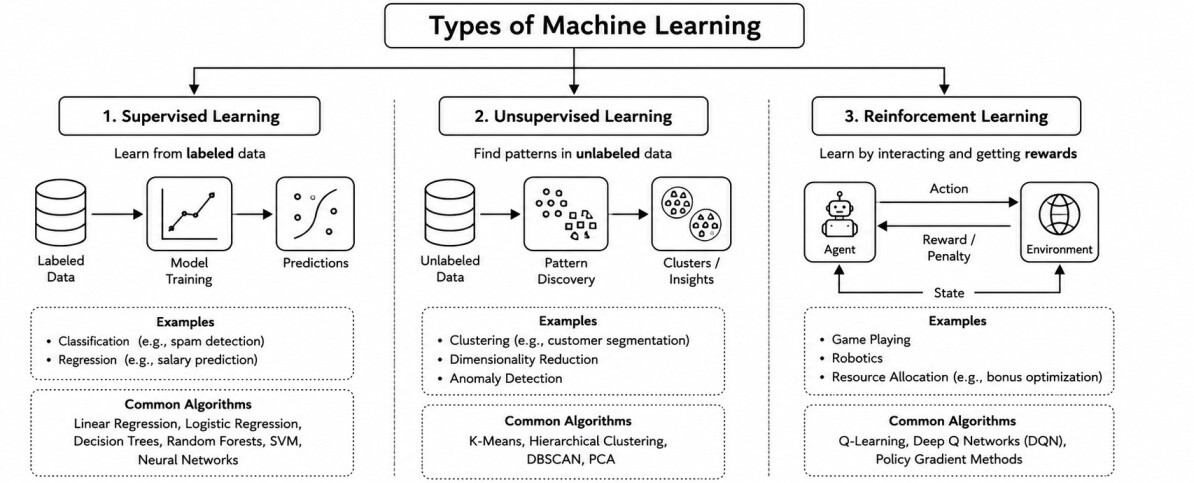
Supervised Learning
Supervised Learning is the most widely used form of Machine Learning, where models are trained on labeled data.In this setting, each input data point is paired with a corresponding correct output, allowing the model to learn a mapping from inputs to outputs.
The core objective of supervised learning is to approximate a function that can generalize well to unseen data.
During training, the model minimizes an error function by comparing its predictions with the actual labels and adjusting its parameters accordingly.
Supervised learning problems can be divided into two major categories:
1. Classification involves predicting discrete labels, such as identifying whether an email is spam or not, or determining if a transaction is fraudulent.
2. Regression involves predicting continuous values, such as house prices, stock values, or temperature forecasts.
Common algorithms used in supervised learning include Linear Regression, Logistic Regression, Decision Trees, Random Forests, Support Vector Machines, and Neural Networks.
The strength of supervised learning lies in its ability to produce highly accurate models when large amounts of labeled data are available.
However, acquiring labeled data can be expensive and time-consuming, which is one of its primary limitations.
Working Mechanism of Supervised Learning
The supervised learning workflow begins with collecting labeled data, where each employee record contains both the input features and the actual salary. The dataset is then divided into training and testing sets.The model is trained on the training data to learn the relationship between employee attributes and salary. After training, it is evaluated on previously unseen employee records to measure how accurately it predicts salaries.
from sklearn.linear_model import LinearRegression
import numpy as np

# Input (years of experience)
X = np.array([[1], [3], [5], [7], [9]])

# Output (salary)
y = np.array([30000, 45000, 60000, 75000, 90000])

# Train the model
model = LinearRegression()
model.fit(X, y)

# Predict salary for an employee with 6 years of experience
predicted_salary = model.predict([[6]])

print("Predicted Salary:", predicted_salary)
Predicted Salary: [67500.]
Unsupervised Learning
Unsupervised Learning deals with unlabeled data, where the model is not provided with explicit outputs. Instead, it must identify hidden structures, patterns, or relationships within the data.Unlike supervised learning, there is no direct feedback mechanism. The model explores the data and organizes it based on inherent similarities or distributions.
Unsupervised learning is primarily used for:
1. Clustering, where data points are grouped based on similarity. For example, customer segmentation in marketing.
2. Dimensionality Reduction, where high-dimensional data is transformed into a lower-dimensional representation while preserving important information.
3. Anomaly Detection, where unusual patterns or outliers are identified.
Common algorithms include K-Means Clustering, Hierarchical Clustering, DBSCAN, and Principal Component Analysis (PCA).
Unsupervised learning is particularly valuable when labeled data is unavailable or when exploring unknown datasets.
However, evaluating the performance of unsupervised models is often more challenging due to the absence of ground truth.
Working Mechanism of Unsupervised Learning
In unsupervised learning, the model is given only the input features without any labels. It discovers hidden patterns by measuring similarities or distances between data points and groups similar records together.Suppose an organization has employee data containing age and years of experience, but does not know how employees should be categorized. A clustering algorithm can automatically group employees with similar characteristics.
from sklearn.cluster import KMeans
import numpy as np

# Employee data: [Age, Years of Experience]
X = np.array([
    [25, 2],
    [28, 3],
    [32, 5],
    [45, 18],
    [48, 20],
    [52, 22]
])

# Group employees into two clusters
kmeans = KMeans(n_clusters=2, random_state=42)
kmeans.fit(X)

print("Cluster Centers:")
print(kmeans.cluster_centers_)

print("Employee Clusters:")
print(kmeans.labels_)
Cluster Centers:
[[28.33  3.33]
 [48.33 20.00]]

Employee Clusters:
[0 0 0 1 1 1]
Reinforcement Learning
Reinforcement Learning (RL) is a fundamentally different paradigm where an agent learns by interacting with an environment and receiving feedback in the form of rewards or penalties.Unlike supervised learning, the agent does not learn from labeled examples. Instead, it improves its decisions through trial and error, with the goal of maximizing the total reward over time.
Suppose a company wants to optimize employee bonus allocations. The agent recommends bonus amounts based on employee performance. If the recommendation improves employee retention and performance, the agent receives a positive reward. Otherwise, it receives a penalty and adjusts its future decisions.
Key components of reinforcement learning include:
1. Agent, the system that recommends bonus allocations.
2. Environment, the organization and its employees.
3. State, employee information such as performance rating, experience, and department.
4. Action, selecting a bonus amount or reward strategy.
5. Reward, positive feedback when business outcomes improve and negative feedback otherwise.
Reinforcement learning is widely used in robotics, game playing, recommendation systems, autonomous systems, and dynamic resource allocation.
Algorithms in this domain include Q-Learning, Deep Q Networks (DQN), and Policy Gradient Methods.
Working Mechanism of Reinforcement Learning
The agent begins with little or no knowledge and continuously interacts with the environment. It balances exploration (trying new bonus strategies) and exploitation (using strategies that have worked well previously). Over time, it learns a policy that maximizes long-term rewards.import numpy as np
# Q-table: 5 employee states, 2 bonus strategies
Q = np.zeros((5, 2))
alpha = 0.1
gamma = 0.9
state = 0
action = 1
reward = 10
next_state = 1
Q[state, action] = Q[state, action] + alpha * (
reward + gamma * np.max(Q[next_state]) - Q[state, action]
)
print(Q)
[[0. 1.]
 [0. 0.]
 [0. 0.]
 [0. 0.]
 [0. 0.]]
For example, an HR platform may use unsupervised learning to group similar employees, supervised learning to predict employee salaries, and reinforcement learning to continuously optimize bonus or reward strategies based on employee outcomes.
Modern AI systems frequently integrate these approaches to build intelligent, adaptive solutions that improve over time.
Conclusion
Supervised, Unsupervised, and Reinforcement Learning represent the three foundational paradigms of Machine Learning, each addressing different types of problems and data scenarios.Supervised learning provides precision through labeled data, unsupervised learning enables discovery in unknown datasets, and reinforcement learning introduces adaptability through interaction and feedback.