While these domains are closely related and frequently overlap in real-world systems, each has a distinct scope, purpose, and set of techniques. Understanding their differences and how they connect is essential for designing scalable, intelligent systems and making informed architectural decisions.
This article takes a deep, structured, and engineering-focused approach to explain these concepts from first principles, progressing toward their relationships, overlaps, and practical implications.
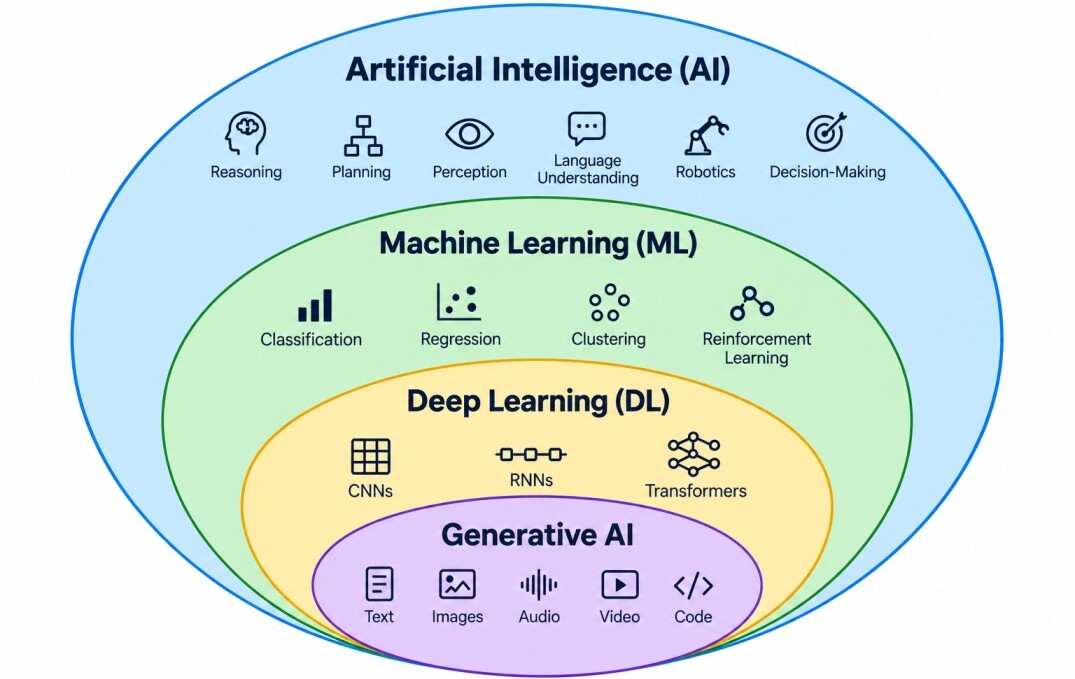
Artificial Intelligence (AI)
Artificial Intelligence is the broadest concept among these domains. It refers to the ability of machines to perform tasks that typically require human intelligence, including reasoning, learning, problem-solving, perception, language understanding, and decision-making.AI is not limited to a single technique or algorithm. It is an umbrella field encompassing multiple approaches developed over decades.
Historically, AI began with rule-based systems, where explicit logic, rules, and decision trees were manually crafted. These systems relied on predefined logic rather than learning from data. Early expert systems in medicine, finance, and other domains operated largely through deterministic rules.
Modern AI has evolved significantly toward data-driven and learning-based systems. AI today includes areas such as Machine Learning, Deep Learning, Natural Language Processing (NLP), Computer Vision, Robotics, Reinforcement Learning, and Generative AI.
In essence, AI answers the question: "How can machines perform tasks that require intelligence?"
Machine Learning (ML)
Machine Learning is a subset of AI that focuses on enabling systems to learn patterns from data and use those learned patterns to make predictions, classifications, or decisions without requiring explicit rules for every possible scenario.Instead of manually programming every rule, developers provide data and an appropriate learning algorithm. The model then learns relationships within that data.
For example, rather than writing thousands of rules to identify spam emails, an ML system can learn patterns from examples of spam and non-spam messages and use those patterns to classify new emails.
Machine Learning can broadly be categorized into three major approaches.
1. Supervised Learning involves training models using labeled data where the expected output is known. Common applications include classification and regression.
2. Unsupervised Learning works with unlabeled data and attempts to discover hidden structures, relationships, or clusters within the data.
3. Reinforcement Learning involves an agent interacting with an environment and learning actions that maximize cumulative rewards.
ML is fundamentally based on statistics, probability, optimization, and computational algorithms. Common techniques include linear regression, logistic regression, decision trees, random forests, support vector machines, and gradient boosting.
Machine Learning answers the question: "How can machines learn from data?"
Deep Learning (DL)
Deep Learning is a specialized subset of Machine Learning that uses artificial neural networks with multiple layers to learn increasingly complex representations from data.Traditional ML algorithms often depend heavily on manually engineered features. Deep Learning reduces this dependency by allowing neural networks to automatically learn useful representations directly from raw or minimally processed data.
A deep neural network consists of multiple layers of interconnected computational units. Each layer transforms the representation produced by the previous layer, allowing the network to learn increasingly abstract patterns.
Training deep neural networks typically involves techniques such as backpropagation, gradient descent, and large-scale optimization.
Deep Learning has driven major advances in areas such as Computer Vision, Natural Language Processing, Speech Recognition, and Generative AI.
Important deep learning architectures include Convolutional Neural Networks (CNNs), Recurrent Neural Networks (RNNs), and, most importantly for modern AI, Transformers.
Deep Learning answers the question: "How can machines learn complex representations from large-scale data?"
Generative AI
Generative AI is a category of AI systems that can generate new content based on patterns learned from existing data. Instead of only predicting a label, score, or numerical value, Generative AI models can produce outputs such as text, images, audio, video, and code.Modern Generative AI is primarily powered by Deep Learning and large-scale foundation models. These models are trained on massive datasets to learn general-purpose representations that can later be adapted to many different tasks.
A major breakthrough in Generative AI has been the Transformer architecture. Transformers use mechanisms such as self-attention to process relationships between elements in sequential data, making them highly effective for language and other modalities.
Large Language Models (LLMs) are a prominent example of Generative AI. Models can generate text, answer questions, summarize documents, translate languages, write code, and perform reasoning-oriented tasks based on their learned representations and subsequent training.
Generative AI systems can also use techniques such as prompt engineering, fine-tuning, Retrieval-Augmented Generation (RAG), and tool calling to improve their usefulness in real-world applications.
Examples of Generative AI applications include AI assistants, code generation, document summarization, content generation, image generation, conversational systems, and enterprise knowledge assistants.
Generative AI answers the question: "How can machines generate new content based on what they have learned?"
Key Differences
The distinction between these domains becomes clearer when viewed through their scope and primary purpose.Artificial Intelligence is the broadest concept. It represents the goal of building systems capable of performing tasks associated with intelligence.
Machine Learning is a technique within AI that enables systems to learn patterns from data and use those patterns to make predictions or decisions.
Deep Learning is a specialized form of Machine Learning based on multi-layer neural networks capable of learning complex representations.
Generative AI focuses on using learned representations to generate new content such as text, images, audio, video, or code. Modern Generative AI is largely built using Deep Learning, foundation models, and architectures such as Transformers.
Therefore, the relationship can be viewed approximately as:
AI → Machine Learning → Deep Learning → Modern Generative AI
However, this should not be interpreted as a strict hierarchy where every Deep Learning system is Generative AI. Generative AI is a capability or application category that heavily relies on modern Deep Learning, but Deep Learning also powers many non-generative systems such as image classification, fraud detection, and predictive analytics.
How AI, ML, DL, and Generative AI Overlap
In real-world systems, these domains rarely exist independently. Instead, they form interconnected layers of technologies and capabilities.Machine Learning provides learning mechanisms within AI. Deep Learning provides powerful neural-network-based approaches within Machine Learning. Generative AI builds on modern Deep Learning to create systems capable of generating new content.
For example, consider an enterprise AI-powered customer support system.
The overall application represents Artificial Intelligence because it performs tasks that traditionally require human intelligence.
Machine Learning may be used to classify customer requests, detect intent, or predict customer behavior.
Deep Learning may power language understanding, speech recognition, embeddings, and other complex representations.
Generative AI may be used to generate natural-language responses, summarize conversations, retrieve relevant knowledge, and assist support agents.
This demonstrates that these concepts are not competing technologies. Instead, they often work together as different layers of an intelligent system.
Conclusion
Artificial Intelligence, Machine Learning, Deep Learning, and Generative AI are closely related but represent different concepts.AI represents the broader goal of building intelligent systems. Machine Learning provides techniques for learning patterns from data. Deep Learning uses multi-layer neural networks to learn complex representations. Generative AI builds on modern deep learning and foundation models to generate new content such as text, images, audio, video, and code.
Understanding these relationships is important because modern production systems rarely rely on a single AI technique. Instead, they combine Machine Learning, Deep Learning, foundation models, Generative AI, retrieval systems, and traditional software architecture to solve complex business problems.
