This lifecycle ensures that models are not only accurate but also scalable, reliable, and maintainable in real-world systems.
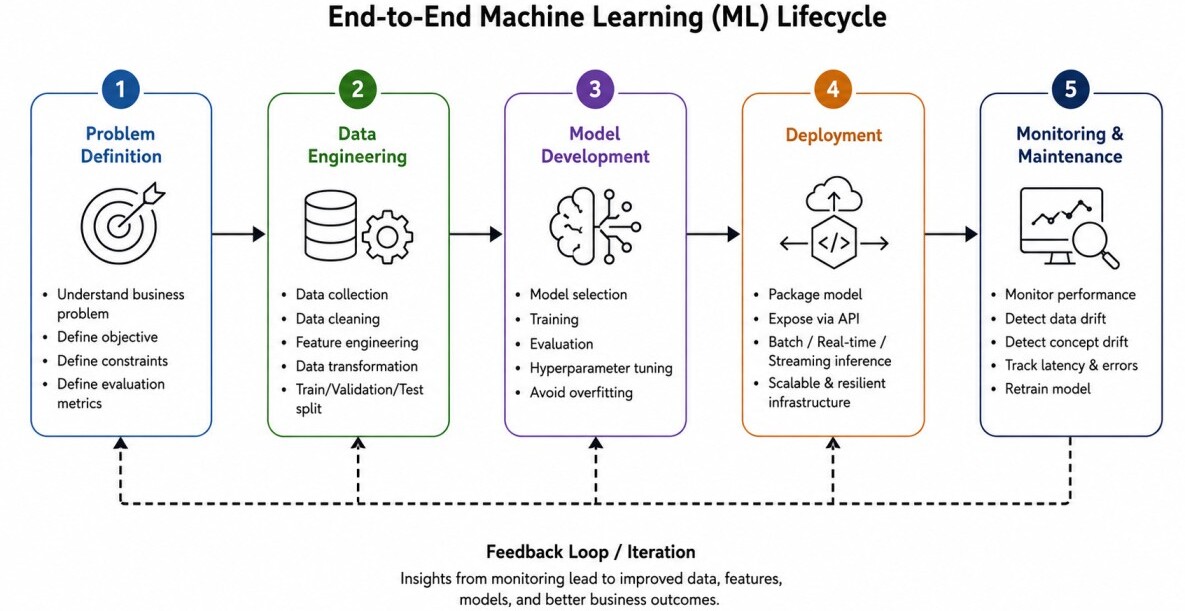
The end-to-end ML lifecycle can be broadly divided into five major stages:
1. Problem Definition,
2. Data Engineering,
3. Model Development,
4. Deployment, and
5. Monitoring.
These stages are interconnected, and improvements in one stage often require revisiting earlier steps.
1. Problem Definition
The Machine Learning lifecycle begins by clearly defining the problem. A well-defined ML problem translates a business requirement into a mathematically solvable task.Suppose an organization wants to predict employee salaries based on factors such as age, years of experience, and job role. Since salary is a continuous value, this is a regression problem.
At this stage, it is essential to define:
1. Objective function, predicting employee salaries as accurately as possible.
2. Constraints, such as prediction latency, scalability, and deployment cost.
3. Evaluation metrics, such as Mean Absolute Error (MAE) or R² Score, to measure how closely the predicted salaries match the actual salaries.
2. Data Engineering
Once the problem is defined, the next step is acquiring and preparing data. This stage includes collecting data from sources such as databases, files, APIs, and streaming systems.Suppose we are building a model to predict employee salaries.
1. Data cleaning, filling missing
Age or Experience values and removing duplicate employee records.
2. Feature engineering, creating a new feature such as
ExperiencePerAge from existing columns.
3. Data transformation, scaling
Age and Experience so both have a similar range.
4. Data splitting, dividing the employee dataset into training, validation, and testing sets.
Example: Data Preparation
import pandas as pd
from sklearn.model_selection import train_test_split
from sklearn.preprocessing import StandardScaler

# Sample employee dataset
data = pd.DataFrame({
    "age": [25, 30, 35, None, 40],
    "experience": [2, 5, 8, 10, None],
    "salary": [40000, 55000, 70000, 85000, 95000]
})

# 1. Data cleaning
data.fillna(data.mean(numeric_only=True), inplace=True)

# 2. Feature engineering
data["experience_per_age"] = data["experience"] / data["age"]

# 3. Data transformation
X = data[["age", "experience", "experience_per_age"]]
y = data["salary"]

scaler = StandardScaler()
X_scaled = scaler.fit_transform(X)

# 4. Data splitting
X_train, X_test, y_train, y_test = train_test_split(
    X_scaled, y, test_size=0.2, random_state=42
)

print(X_train)
[[-1.50 -1.44 -1.32]
 [ 0.00  0.18  0.41]
 [ 1.18  1.31  0.92]
 [ 0.32 -0.05 -0.01]]
3. Model Development
In this stage, the prepared data is used to build and train Machine Learning (ML) models. The goal is to identify patterns and relationships that generalize well to unseen data.Continuing our employee salary prediction example, we use the prepared employee data to train a model that predicts salary based on factors such as age, experience, and other features.
Model development involves selecting appropriate algorithms, training models, tuning hyperparameters, and evaluating performance using validation datasets.
Important considerations include:
1. Model selection, choosing an algorithm such as Linear Regression, Decision Tree, or Random Forest for salary prediction.
2. Training, allowing the model to learn the relationship between employee features and salaries.
3. Evaluation, measuring prediction quality using metrics such as Mean Absolute Error (MAE) or R² Score.
4. Hyperparameter tuning, adjusting settings such as the number of trees or tree depth to improve prediction accuracy.
A key challenge in this stage is avoiding overfitting, where the model performs well on training data but poorly on unseen employee records.
Example: Model Training
from sklearn.ensemble import RandomForestRegressor

# Train a regression model
model = RandomForestRegressor(random_state=42)
model.fit(X_train, y_train)

# Evaluate the model
score = model.score(X_test, y_test)

print("R² Score:", round(score, 2))
R² Score: 0.94
4. Deployment
Once a model is trained and validated, it must be integrated into a production system where it can generate predictions for new data.Deployment is where traditional software engineering meets Machine Learning. It involves packaging the model, exposing it via APIs, and ensuring it can handle production workloads.
For our employee salary prediction example, the trained model can be deployed as an API. HR applications or recruitment portals can send employee details to the API, and it returns the predicted salary.
Common deployment strategies include:
1. Batch inference, predicting salaries for thousands of employees at scheduled intervals.
2. Real-time inference, predicting a salary instantly when a recruiter enters employee details.
3. Streaming inference, continuously predicting salaries as employee records arrive from a data stream.
In production environments, models are often deployed using microservices, containerization, and orchestration platforms to ensure scalability and resilience.
Example: Model Serving API
from flask import Flask, request, jsonify

app = Flask(__name__)

# Assume 'model' is the trained RandomForestRegressor
# from the previous section.

@app.route("/predict", methods=["POST"])
def predict_salary():
    data = request.json

    features = [[
        data["age"],
        data["experience"],
        data["experience_per_age"]
    ]]

    predicted_salary = model.predict(features)[0]

    return jsonify({
        "predicted_salary": round(predicted_salary, 2)
    })

if __name__ == "__main__":
    app.run(debug=True)
POST /predict
{
  "age": 30,
  "experience": 5,
  "experience_per_age": 0.167
}
{
  "predicted_salary": 55680.42
}
5. Monitoring and Maintenance
Deployment is not the final step in the ML lifecycle. Once in production, models must be continuously monitored to ensure they remain accurate and reliable over time.Continuing our employee salary prediction example, the deployed model predicts salaries for new employees. Over time, changes in hiring trends, job roles, or market salaries may reduce the model's prediction accuracy.
Monitoring involves tracking:
1. Data drift, where the distribution of employee attributes such as age or experience changes over time.
2. Concept drift, where the relationship between employee attributes and salary changes because of new compensation policies or market conditions.
3. Performance metrics, such as Mean Absolute Error (MAE), prediction latency, and API error rates.
When degradation is detected, the model should be retrained using recent employee data before prediction quality deteriorates further.
Example: Monitoring Model Performance
from sklearn.metrics import mean_absolute_error

# Actual and predicted salaries
actual = [50000, 62000, 71000, 83000]
predicted = [52000, 60000, 70000, 85000]

mae = mean_absolute_error(actual, predicted)

print("Mean Absolute Error:", mae)
Mean Absolute Error: 1750.0
Feedback Loops and Iteration
The ML lifecycle is inherently iterative. Insights gained during monitoring often lead back to earlier stages such as data collection, feature engineering, or model development.Continuing our employee salary prediction example, suppose the deployed model starts producing less accurate salary predictions because the company has introduced new job roles and revised its compensation policies.
This may require:
1. Collecting more data, including salaries for newly hired employees and new job roles.
2. Engineering better features, such as
job_level, department, or location, to better explain salary differences.
3. Choosing a different model, replacing the existing model with one that better captures the updated salary patterns.
This feedback loop enables the model to continuously improve as new data becomes available. Unlike traditional software, where business rules are manually updated, Machine Learning systems evolve by learning from fresh data and retraining models over time.
Conclusion
The end-to-end Machine Learning lifecycle is much more than simply training a model. As we saw in our employee salary prediction example, the process begins with defining the problem, continues through data preparation and model development, and extends into deployment, monitoring, and continuous improvement.Each stage is essential. High-quality data leads to better models, reliable deployment makes predictions available to applications, and continuous monitoring ensures the model remains accurate as employee data and business conditions evolve.