Today, technologies such as Generative AI, Retrieval-Augmented Generation (RAG), AI Agents, and Agentic AI represent different levels of intelligence and automation, each designed to solve different types of problems.
In this article, we will understand what each of these technologies is, how it works, along with its strengths, limitations, and the key differences between them.
What is Generative AI?
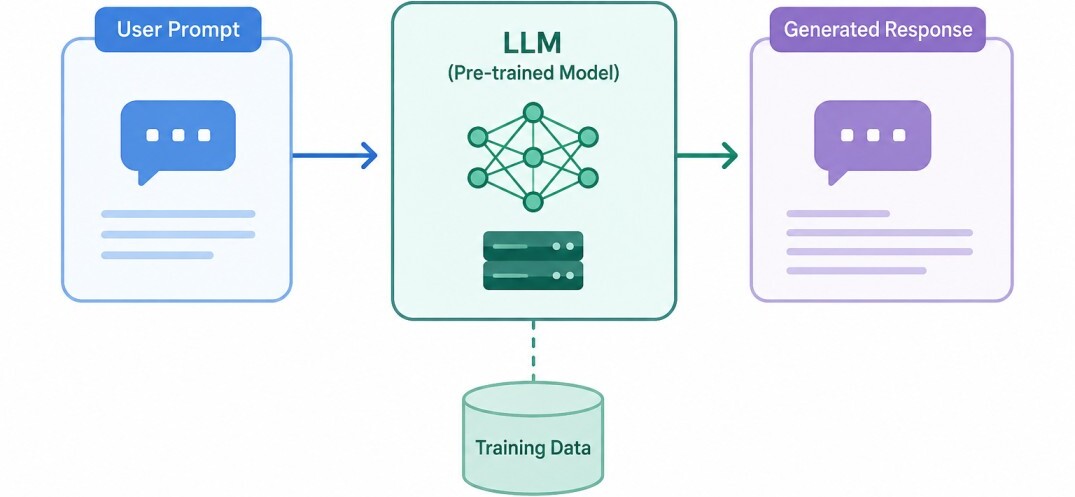
Generative AI refers to artificial intelligence systems capable of creating new content rather than simply retrieving existing information.These systems learn patterns from enormous datasets during training and use that knowledge to generate human-like text, source code, summaries, translations, emails, reports, images, audio, and many other forms of content.
The most popular implementations of Generative AI are Large Language Models (LLMs) such as GPT, Claude, Gemini, Llama, and Mistral.
These models are trained on billions or even trillions of words collected from books, websites, research papers, documentation, and publicly available source code.
Instead of memorizing answers, they learn statistical relationships between words and concepts, enabling them to generate coherent responses for previously unseen questions.
When a user submits a prompt, the model predicts one token at a time until it generates a complete response.
It does not search the internet or query a database during this process. Every response is produced using the knowledge stored within the trained model itself.
Example
The user asks:How many annual leaves do employees get?"Many companies provide around 20–30 annual leaves..."How Generative AI Works?
A user first provides a prompt or question. The prompt is converted into numerical tokens that the Large Language Model can process.The model analyzes these tokens using the knowledge acquired during training and repeatedly predicts the next most probable token until the response is complete.
The generated output is then converted back into human-readable text and returned to the user.
Strengths of Generative AI
Generative AI excels at producing high-quality human-like content across a wide variety of domains.It can answer general knowledge questions, write code, generate documentation, summarize lengthy documents, translate between languages, explain technical concepts, and assist with brainstorming and creative writing.
Since everything happens inside the trained model, responses are generated quickly without requiring additional infrastructure such as databases or vector search engines.
It also serves as the foundation upon which more advanced AI architectures like RAG and AI Agents are built.
Limitations of Generative AI
The primary limitation of Generative AI is that it only knows what it learned during training.It has no inherent access to recent events, private enterprise documents, or organization-specific knowledge. As a result, it may generate hallucinations, producing answers that sound convincing but are factually incorrect.
It also cannot execute actions such as calling APIs, querying databases, sending emails, or performing business operations.
Without additional components, it functions solely as a content generation system.
What is Retrieval-Augmented Generation (RAG)?
Retrieval-Augmented Generation (RAG) is an architecture that combines the language generation capabilities of a Large Language Model with information retrieved from external knowledge sources.Instead of relying only on the model's training data, RAG allows the LLM to access relevant documents at inference time, resulting in more accurate and up-to-date responses.
This approach is especially valuable in enterprise environments where important information resides in internal documentation rather than the public internet.
Company policies, product manuals, engineering documentation, HR guidelines, legal contracts, financial reports, support tickets, and knowledge bases can all be indexed and made searchable through a RAG pipeline.
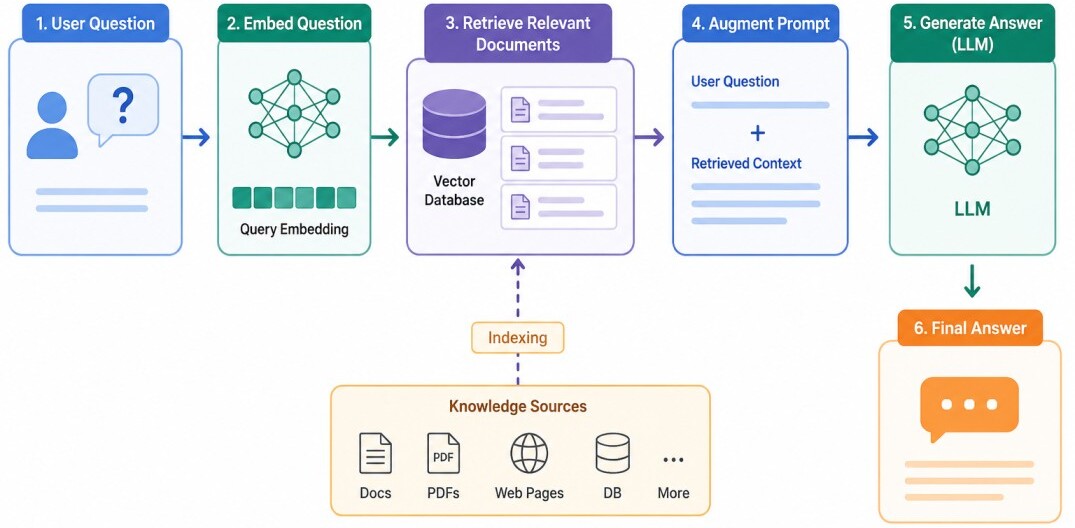
Rather than asking the LLM to answer from memory, RAG first searches for relevant information and then supplies that information as additional context.
The language model generates its answer using both the retrieved documents and its own general knowledge.
Since enterprise documents can be updated at any time, RAG systems remain current without requiring expensive model retraining.
Simply updating the indexed documents makes new information immediately available to users.
Example
The user asks the same question:How many annual leaves do employees get?"According to the HR Policy v3.2, full-time employees receive 24 annual leaves."How RAG Works?
Documents are first divided into smaller chunks. Each chunk is converted into a numerical vector called an embedding using an embedding model.These embeddings are stored inside a Vector Database or vector-enabled search engine such as Elasticsearch.
When a user submits a question, the same embedding model converts the query into a vector.
A similarity search identifies the most relevant document chunks. These retrieved chunks are combined with the user's original prompt and sent to the Large Language Model.
The LLM then generates a response grounded in the retrieved information, significantly improving accuracy while reducing hallucinations.
Strengths of RAG
RAG enables language models to answer questions using private enterprise knowledge while significantly reducing hallucinations.It supports continuously changing information without requiring model retraining, making it ideal for business documentation, technical manuals, compliance policies, customer support, and internal knowledge management.
Since only the knowledge base needs updating, maintaining a RAG system is considerably more cost-effective than retraining a large language model whenever information changes.
Limitations of RAG
The quality of a RAG system depends heavily on the retrieval process. If the retrieval component fails to identify the correct documents, the language model cannot generate an accurate answer.Building a production-grade RAG system also requires additional infrastructure, including document chunking pipelines, embedding generation, vector databases, indexing processes, and similarity search.
Furthermore, RAG is primarily designed for information retrieval and question answering.
Unlike AI Agents, it cannot independently plan tasks, invoke external tools, execute workflows, or perform business operations.
What are AI Agents?
AI Agents are AI-powered systems that combine a Large Language Model (LLM), memory, and external tools to reason, plan, make decisions, and execute actions in order to accomplish a specific goal.Unlike a traditional chatbot that simply generates text, an AI Agent understands the user's objective, determines what needs to be done, selects the appropriate tools, performs multiple actions, evaluates intermediate results, and continues working until the task is completed.
At the core of an AI Agent is a Large Language Model (LLM), which serves as the reasoning engine.
AI Agents also use memory to maintain conversation context, remember previous interactions, store intermediate results, or retain user preferences, enabling more intelligent and personalized decision-making.
To interact with the real world, AI Agents are connected to various external tools such as web search engines, databases, REST APIs, email services, calendars, cloud platforms and business applications.
The LLM determines which tools to use, what information needs to be collected, and what action should be performed next.
Unlike Generative AI or RAG, which primarily focus on generating responses, AI Agents focus on achieving goals.
They can execute multi-step workflows, adapt to changing conditions, recover from failures, and interact with multiple systems before producing the final result.
Example
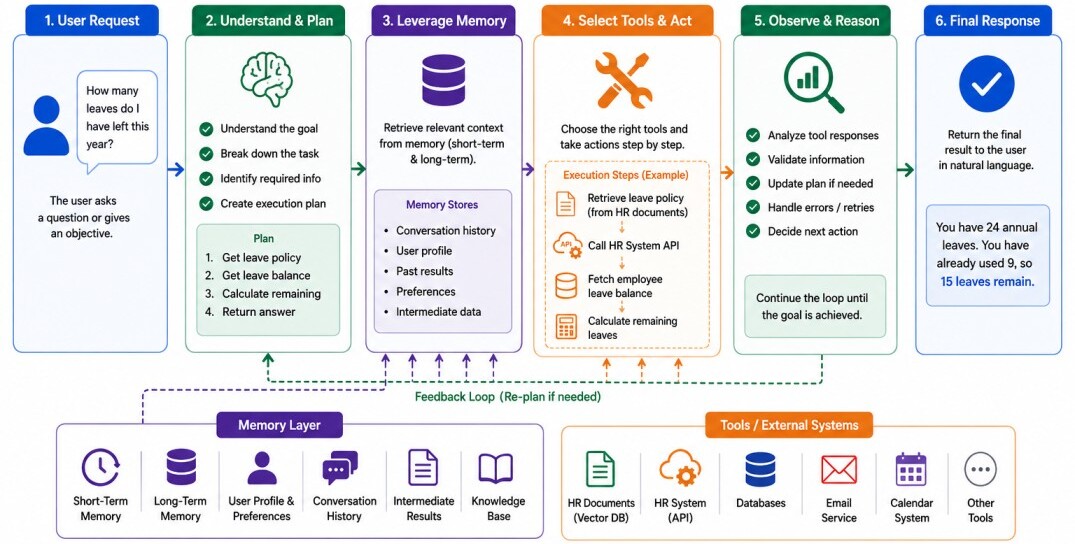
Now the user asks:How many leaves do I have left this year?It retrieves the company's leave policy, calls the HR system, fetches the employee's current leave balance, calculates the remaining leaves, and generates the final response.
"You have 24 annual leaves. You have already used 9, so 15 leaves remain."How AI Agents Work?
An AI Agent begins by analyzing the user's request to understand the desired goal.The Large Language Model (LLM) reasons about the problem and creates an execution plan while using its memory to retain conversation context, user preferences, and relevant information required during execution.
Based on the execution plan, the agent identifies the external tools required to complete the task, such as APIs, databases, search engines, calculators, or code execution environments.
The selected tools are invoked to retrieve information or perform specific actions. The results from these tools are then passed back to the LLM.
The LLM combines the tool outputs with its reasoning and memory to generate the final response, which is then returned to the user.
Strengths of AI Agents
AI Agents automate complex multi-step workflows that would normally require significant human effort.They combine reasoning, memory, and external tools to solve problems dynamically instead of following a fixed sequence of instructions.
They can interact with enterprise systems, execute APIs, query databases, send emails, schedule meetings, perform calculations, generate reports, and integrate with business applications.
Limitations of AI Agents
The effectiveness of an AI Agent depends heavily on the reasoning capability of the underlying language model, the quality of its memory, and the reliability of the connected tools.Incorrect reasoning or incomplete context may result in poor decisions or failed workflows.
Since agents often invoke multiple APIs and perform several reasoning cycles, they typically have higher latency and operational costs than standard chatbots.
Granting AI Agents access to enterprise systems also introduces security and governance challenges, requiring robust authentication, authorization, auditing, monitoring, and permission management mechanisms.
What is Agentic AI?
Agentic AI represents the next evolution of artificial intelligence, where multiple intelligent agents work autonomously toward achieving complex objectives with minimal human intervention.Rather than responding to individual requests, Agentic AI continuously plans, reasons, coordinates, executes, evaluates progress, and adapts its strategy until the overall objective is successfully completed.
While an AI Agent typically focuses on executing a single user request, Agentic AI manages long-running goals that may involve numerous interconnected tasks, multiple specialized agents, and continuous decision making.
Each agent is responsible for a specific role, such as planning, research, software development, testing, deployment, monitoring, or security review.
These agents communicate with one another, exchange information through shared memory, and coordinate their activities to accomplish a common objective.
Agentic AI systems are designed to operate with a high degree of autonomy.
Instead of requiring human instructions for every step, they continuously assess the current state, identify remaining work, recover from failures, revise execution plans, and optimize their approach until the goal is achieved.
Example
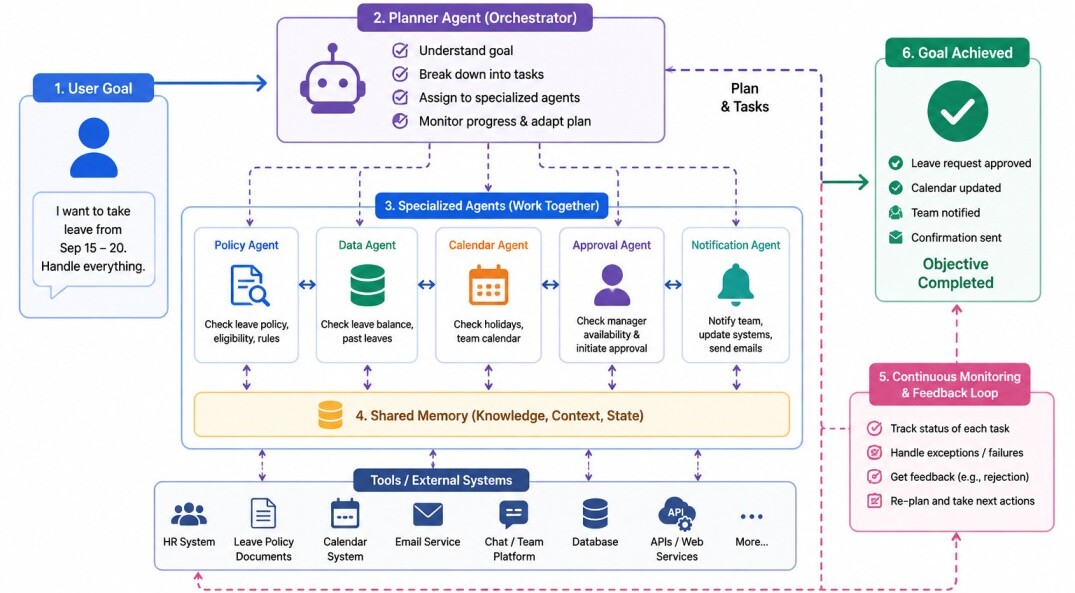
The user asks:"I want to take leave from September 15–20. Handle everything."It checks the employee's leave balance, verifies the company's leave policy, identifies any public holidays, checks the manager's availability, creates and submits the leave request, updates the HR system, blocks the employee's calendar, notifies the team, and sends a confirmation email.
If the manager rejects the request or requests changes, the system analyzes the feedback, updates its plan, and takes the appropriate next actions, such as notifying the employee, suggesting alternative dates, modifying the request, or resubmitting it for approval.
It continues monitoring the workflow until the leave request is successfully completed.
Unlike an AI Agent that executes a predefined task, Agentic AI continuously reasons, makes autonomous decisions, adapts based on feedback, and coordinates multiple specialized agents until the overall objective is achieved.
How Agentic AI Works?
The process begins with a high-level objective provided by the user. A Planner Agent analyzes the objective and decomposes it into multiple smaller tasks.These tasks are assigned to specialized agents based on their capabilities.
Each agent independently performs reasoning, invokes tools, retrieves information, and completes its assigned responsibilities.
Throughout execution, the agents exchange information using shared memory and continuously monitor each other's progress.
If a task fails or produces an unexpected result, the affected agent revises its approach, retries the operation, or requests assistance from another specialized agent.
The Planner Agent continuously evaluates overall progress and updates the execution strategy whenever necessary.
The process continues until every task has been completed and the final objective has been achieved.
Strengths of Agentic AI
Agentic AI is capable of solving highly complex problems by coordinating multiple specialized agents that work together toward a common objective.It supports autonomous planning, adaptive decision making, continuous monitoring, self-correction, failure recovery, and long-running workflow execution.
Because individual agents specialize in different responsibilities, large tasks can be completed more efficiently and with greater scalability than using a single AI Agent.
This architecture is particularly valuable for enterprise automation, autonomous software development, research, cybersecurity, and large-scale business operations.
Limitations of Agentic AI
Agentic AI systems are significantly more complex to design, develop, and operate than traditional AI applications.Coordinating multiple autonomous agents requires sophisticated orchestration, memory management, communication protocols, monitoring, and governance.
Since several agents may invoke numerous language models and external tools simultaneously, infrastructure costs can become substantial.
Autonomous decision making also introduces challenges related to predictability, security, compliance, and accountability, making human oversight essential for critical business and regulatory workflows.
Conclusion
Generative AI provides the foundation by enabling natural language understanding and content generation. RAG improves accuracy by grounding responses in external knowledge.AI Agents transform language models into intelligent systems capable of reasoning, planning, and executing actions through external tools.
Agentic AI extends this further by enabling multiple autonomous agents to collaborate, adapt, and complete complex objectives with minimal human intervention.
A single system may use a Large Language Model for conversation, RAG for enterprise knowledge retrieval, AI Agents for task execution, and Agentic AI for coordinating long-running business workflows.