Why Thread Pools Exist?
Although theThread class provides a simple way to execute code concurrently, manually managing hundreds or thousands of threads quickly becomes expensive and difficult.
Every Java thread requires its own stack memory. Depending on the JVM configuration, a single thread may consume hundreds of kilobytes or even several megabytes of memory.
Creating and destroying threads is also relatively expensive because it requires coordination between the JVM and the operating system. As a result, frequent thread creation can significantly impact application performance.
Consider a web server that receives ten thousand client requests every minute. If the server creates a new thread for every request, thousands of threads may be continuously created and destroyed.
Instead of processing user requests, a significant portion of CPU time is wasted managing thread lifecycles.
One of the biggest risks of this approach is thread explosion, where an application creates threads faster than they can complete their work.
As requests continue to arrive, the number of active threads keeps growing, leading to excessive memory consumption, heavy context switching, degraded performance, and potentially an
OutOfMemoryError if system resources are exhausted.
Thread pools solve this problem by creating a fixed or dynamically managed collection of worker threads. Instead of creating a new thread for every task, incoming tasks are placed into a queue and executed by available worker threads.
After completing one task, a worker thread immediately becomes available to process another, allowing threads to be reused efficiently.
Thread pools not only prevent thread explosion but also improve performance, reduce resource consumption, and provide much better scalability for concurrent applications.
When threads are created manually, developers are responsible for managing their entire lifecycle, including deciding when threads should start, how many should run concurrently, how failures should be handled, and when threads should terminate.
As applications grow larger, coordinating dozens or hundreds of threads manually becomes increasingly complex and error-prone.
The Executor Framework automates these responsibilities, allowing developers to focus on business logic rather than thread management.
What is a Thread Pool?
A thread pool is a collection of pre-created worker threads that are reused to execute multiple tasks. Instead of creating a new thread whenever work needs to be performed, tasks are submitted to the pool.Whenever a worker thread becomes available, it retrieves the next task from the queue and executes it. A thread pool typically consists of three main components:
1. A collection of worker threads that perform the actual work.
2. A task queue that stores tasks waiting to be executed.
3. A scheduler that assigns queued tasks to available worker threads.
This architecture minimizes thread creation overhead while keeping the CPU efficiently utilized.
Thread Pool Architecture
The internal flow of a thread pool can be visualized as follows: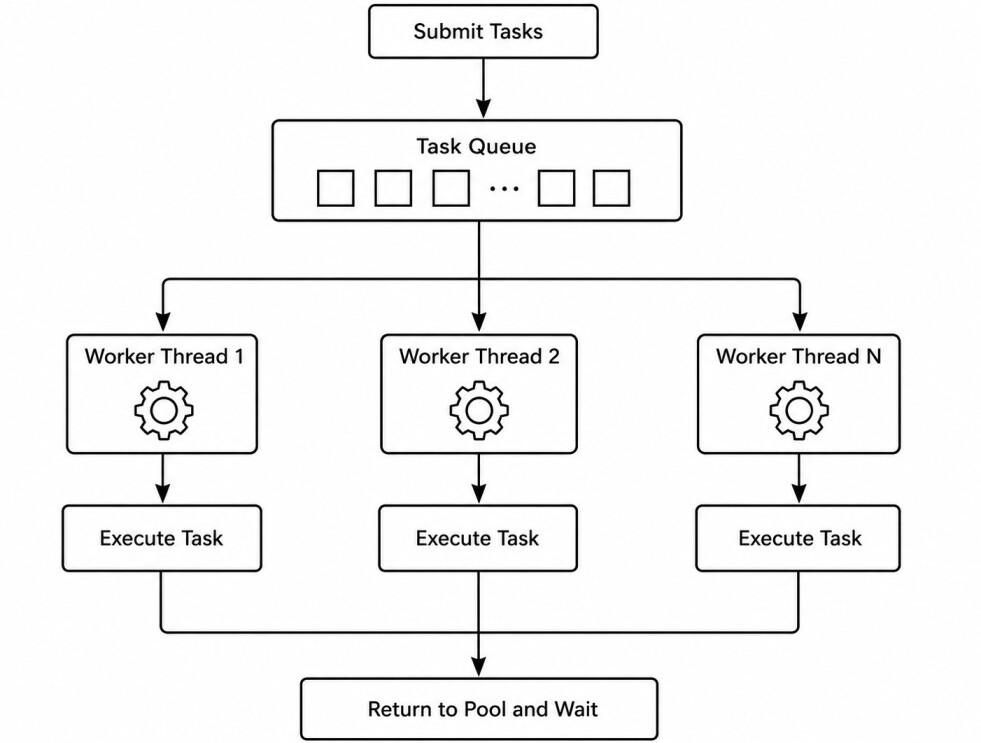
The key advantage of a thread pool is thread reuse. Unlike manually created threads, worker threads are not destroyed after completing a task. Instead, they remain alive inside the pool and wait for additional work.
For example, suppose a pool contains four worker threads. When eight tasks are submitted, the first four tasks begin executing immediately while the remaining four are placed into the task queue.
As each worker completes its task, it retrieves the next task from the queue without creating a new thread.
Because the same worker thread processes many different tasks throughout its lifetime, the application avoids the repeated cost of thread creation and destruction.
Executor Framework
Java introduced the Executor Framework as part of thejava.util.concurrent package in Java 5. Instead of creating and managing threads directly, the Executor Framework separates task submission from task execution.
Developers simply submit tasks to an executor, and the framework decides when and how those tasks should be executed using a pool of worker threads.
This abstraction greatly simplifies concurrent programming while improving scalability and performance.
The Executor Framework consists of several key interfaces and implementations, with the most important being
Executor, ExecutorService, and the Executors utility class.
Executor Interface
The foundation of the Executor Framework is theExecutor interface.
public interface Executor {
    void execute(Runnable command);
}execute(), whose responsibility is simply to accept a task for execution.
The caller does not need to know whether the task will run immediately, be queued for later execution, or be executed by another thread.
A simple example is shown below:
import java.util.concurrent.Executor;
import java.util.concurrent.Executors;

Executor executor = Executors.newSingleThreadExecutor();
executor.execute(() -> System.out.println("Task executed"));Runnable task to the executor. The Executor Framework is responsible for selecting an available worker thread and executing the task.
Although the
Executor interface provides a simple abstraction for task execution, it offers only minimal functionality.
It does not provide methods for shutting down the executor, submitting tasks that return results, or monitoring task completion.
These capabilities are provided by the more powerful
ExecutorService interface.
ExecutorService Interface
ExecutorService extends the Executor interface and adds lifecycle management along with support for asynchronous task execution.
public interface ExecutorService extends Executor {
}execute(), it provides methods for:
- Submitting tasks that return results
- Gracefully shutting down thread pools
- Cancelling tasks
- Waiting for task completion
- Managing executor lifecycle
A typical example is shown below:
import java.util.concurrent.ExecutorService;
import java.util.concurrent.Executors;

ExecutorService executor = Executors.newFixedThreadPool(4);
executor.execute(() -> System.out.println("Task executed"));
executor.shutdown();Executor interface, ExecutorService allows the application to properly terminate the thread pool when it is no longer needed.
Executors Utility Class
Creating thread pools directly using their implementation classes can be cumbersome. To simplify thread pool creation, Java provides theExecutors utility class.
It contains several convenient factory methods for creating commonly used thread pools.
Executors.newFixedThreadPool(4);
Executors.newCachedThreadPool();
Executors.newSingleThreadExecutor();
Executors.newScheduledThreadPool(2);ExecutorService, allowing developers to focus on application logic instead of thread pool configuration.
Fixed Thread Pool
A fixed thread pool creates a fixed number of worker threads that remain alive throughout the lifetime of the executor.ExecutorService executor = Executors.newFixedThreadPool(4);If four tasks are already executing and additional tasks are submitted, they are placed into an internal queue until one of the worker threads becomes available.
          Tasks Submitted

Task 1 ─────────────► Worker 1
Task 2 ─────────────► Worker 2
Task 3 ─────────────► Worker 3
Task 4 ─────────────► Worker 4
Task 5 ─────────────► Waiting Queue
Task 6 ─────────────► Waiting QueueA fixed thread pool is ideal when the application should limit the maximum number of concurrent threads.
It is commonly used by web servers, REST APIs, and enterprise applications where controlling resource usage is important.
Cached Thread Pool
A cached thread pool creates worker threads dynamically as needed.ExecutorService executor = Executors.newCachedThreadPool();This makes cached thread pools suitable for applications where many short-lived asynchronous tasks are submitted intermittently.
However, because the number of threads is not bounded, a cached thread pool can create a very large number of threads under heavy load.
Therefore, it should be used carefully in high-traffic systems.
Single Thread Executor
A single-thread executor maintains exactly one worker thread. ExecutorService executor = Executors.newSingleThreadExecutor(); This makes a single-thread executor useful when task ordering must be preserved or when shared resources should never be accessed simultaneously.
Typical use cases include logging systems, sequential event processing, file writing, and background maintenance tasks.
How Tasks are Submitted?
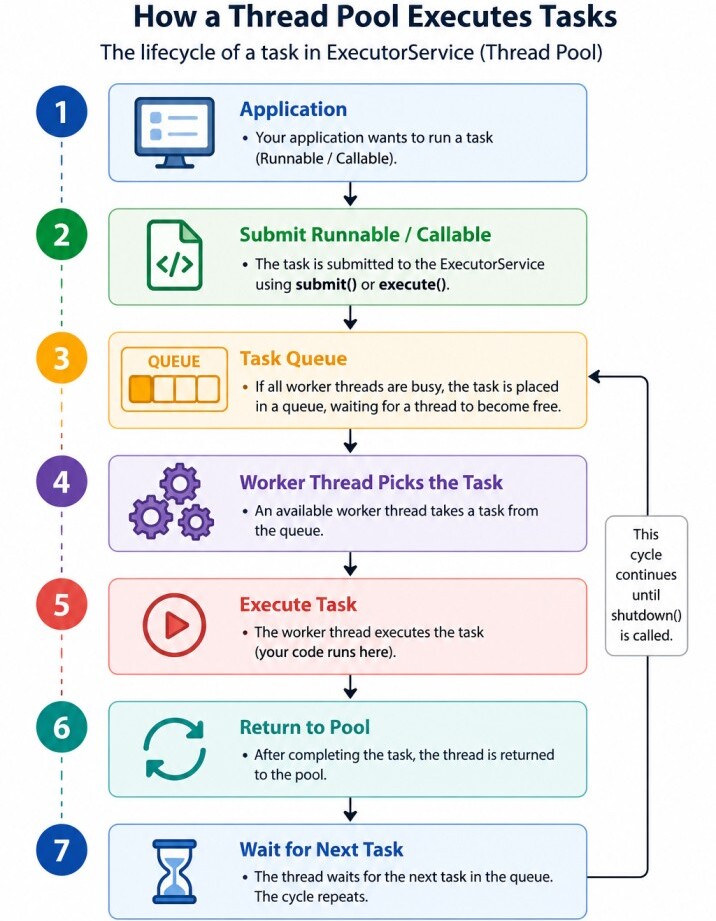
One of the biggest advantages of the Executor Framework is that developers submit tasks rather than managing threads directly.When a task is submitted, it is first placed into the thread pool's internal task queue.
Whenever a worker thread becomes available, it retrieves the next task from the queue, executes it, and then immediately returns to the pool to wait for more work.
The overall lifecycle looks as follows:
execute() vs submit()
TheExecutorService interface provides two primary methods for submitting tasks: execute() and submit().
Although both methods schedule tasks for execution by a worker thread, they differ significantly in terms of return values, exception handling, and supported task types.
execute()
Theexecute() method is inherited from the Executor interface and accepts a Runnable task.
void execute(Runnable command) ExecutorService executor = Executors.newFixedThreadPool(2);
executor.execute(() -> System.out.println("Executing task"));execute() when the task performs an action but does not return a result, such as writing to a log, sending a notification, or processing a background job.
submit()
Thesubmit() method is defined by the ExecutorService interface and supports both Runnable and Callable tasks.
Future submit(Runnable task);
Future submit(Callable task); execute(), the submit() method returns a Future object that represents the pending result of the asynchronous computation.
ExecutorService executor = Executors.newFixedThreadPool(2);
Future future = executor.submit(() -> 100);
System.out.println(future.get());
executor.shutdown(); Future allows the application to retrieve the result once the computation completes.
Exception Handling
Another important difference involves exception handling.If a task submitted using
execute() throws an unchecked exception, it is propagated to the executing thread's UncaughtExceptionHandler (or printed to the console if no handler is configured).
executor.execute(() -> {
    throw new RuntimeException("Something went wrong");
});submit(), exceptions are captured inside the associated Future. They are not thrown immediately. Instead, they are reported when Future.get() is invoked.
Future future = executor.submit(() -> {
    throw new RuntimeException("Something went wrong");
});

try {
    future.get();
} catch (Exception e) {
    System.out.println(e.getCause());
}Shutting Down an ExecutorService
Worker threads created by anExecutorService remain alive until the executor is explicitly shut down. Simply allowing the application to finish submitting tasks does not automatically terminate the thread pool.
Failing to shut down an executor can cause the JVM to continue running because the worker threads remain active and continue waiting for new tasks.
shutdown()
Theshutdown() method initiates a graceful shutdown.
executor.shutdown(); - No new tasks are accepted.
- Previously submitted tasks continue executing.
- The executor terminates only after all queued tasks complete.
This is the recommended way to terminate an executor in most applications.
shutdownNow()
Sometimes an application must terminate immediately. executor.shutdownNow(); Because interruption is cooperative, tasks may ignore the interruption request if they do not check the interrupt status or respond to
InterruptedException.
Therefore,
shutdownNow() should generally be reserved for emergency shutdown scenarios.
awaitTermination()
Sometimes the application needs to wait until all submitted tasks have completed before continuing.executor.shutdown();
executor.awaitTermination(30, TimeUnit.SECONDS);- All tasks complete successfully.
- The specified timeout expires.
- The waiting thread is interrupted.
It is commonly used during application shutdown to ensure that background tasks finish gracefully.
Conclusion
The Executor Framework provides a powerful abstraction for managing concurrent task execution in Java.By separating task submission from thread management, it allows applications to reuse worker threads efficiently, reducing thread creation overhead while improving scalability and responsiveness.
The
ExecutorService interface, together with the various thread pool implementations, offers flexible solutions for a wide range of concurrent workloads.