What is an Interface?
An interface defines a contract that specifies what a class can do without dictating how it performs those operations.Any class that implements an interface agrees to provide implementations for its abstract methods.
Unlike inheritance, where a class acquires behavior from a parent class, an interface focuses on defining capabilities that multiple unrelated classes can share.
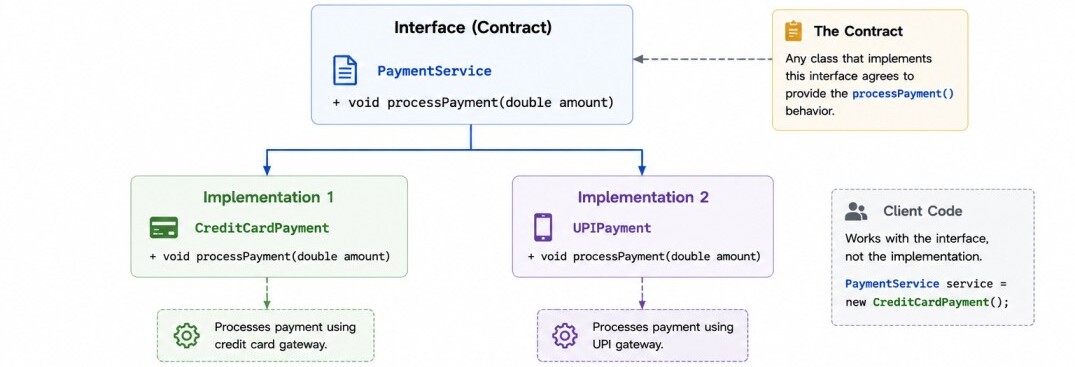
public interface PaymentService {
    void processPayment(double amount);
}public class CreditCardPayment implements PaymentService {
@Override
public void processPayment(double amount) {
System.out.println("Processing credit card payment.");
}
}public class UPIPayment implements PaymentService {
@Override
public void processPayment(double amount) {
System.out.println("Processing UPI payment.");
}
}Interfaces Enable Polymorphism
One of the biggest advantages of interfaces is that application code depends on the interface rather than a specific implementation.For example, the following method works with any payment provider implementing the interface.
public class CheckoutService {

    public void checkout(PaymentService paymentService) {
        paymentService.processPayment(5000);
    }
}Interfaces promote loose coupling by allowing application code to depend on contracts instead of concrete implementations.
Interface Inheritance
Interfaces can inherit from other interfaces using the extends keyword.Unlike classes, an interface may extend multiple interfaces, allowing it to combine multiple contracts into a single, more specialized contract.
When an interface extends another interface, it inherits all of its abstract, default, and static method declarations (although static methods are not inherited by implementing classes).
Any class implementing the child interface must satisfy the contracts defined by all parent interfaces.
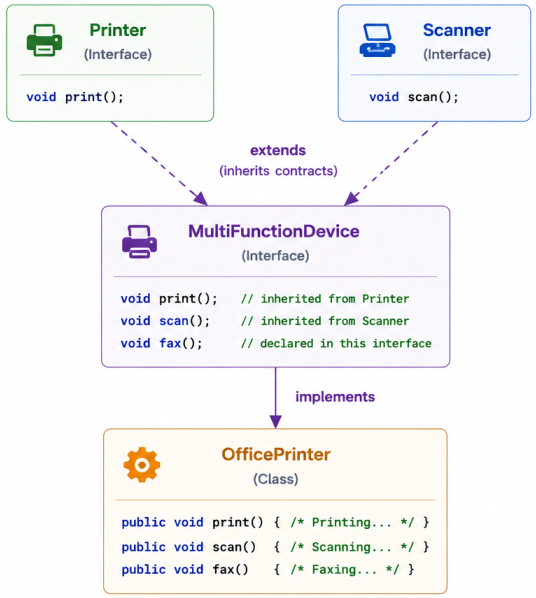
public interface Printer {
    void print();
}

public interface Scanner {
    void scan();
}

public interface MultiFunctionDevice extends Printer, Scanner {
    void fax();
}A class implementing the child interface must implement every inherited method.
public class OfficePrinter implements MultiFunctionDevice {
    @Override
    public void print() {
        System.out.println("Printing...");
    }

    @Override
    public void scan() {
        System.out.println("Scanning...");
    }

    @Override
    public void fax() {
        System.out.println("Faxing...");
    }
}The Java Collections Framework makes extensive use of interface inheritance.
For example, the List, Queue, and Set interfaces all extend the Collection interface, inheriting common operations while defining their own specialized behavior.
What is an Abstract Class?
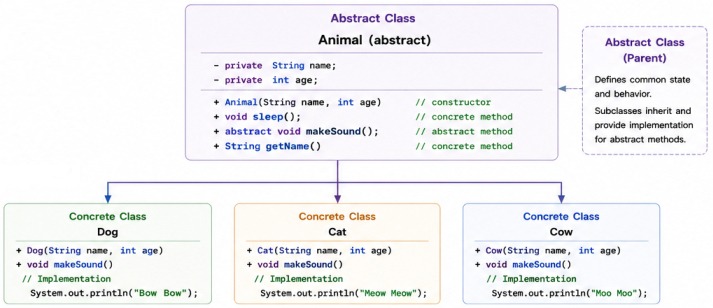
An abstract class is a partially implemented class that cannot be instantiated directly.It provides a common base implementation for related classes while allowing subclasses to provide implementations for operations that vary.
Unlike an interface, an abstract class can contain both abstract methods and fully implemented methods.
It can also define constructors, instance variables, and common business logic shared by all subclasses.
public abstract class Employee {

    private String name;

    public Employee(String name) {
        this.name = name;
    }

    public void printName() {
        System.out.println(name);
    }

    public abstract double calculateSalary();
}public class FullTimeEmployee extends Employee {
public FullTimeEmployee(String name) {
super(name);
}
@Override
public double calculateSalary() {
return 80000;
}
}public class Contractor extends Employee {
public Contractor(String name) {
super(name);
}
@Override
public double calculateSalary() {
return 50000;
}
}An abstract class reduces code duplication by centralizing shared fields, constructors, validation logic, and utility methods.
Subclasses inherit this common functionality while implementing only the behavior that varies.
Interface vs Abstract Class
Although both interfaces and abstract classes are used to achieve abstraction, they are designed to solve different problems.The following table summarizes the major differences.
| Feature | Interface | Abstract Class |
|---|---|---|
| Purpose | Defines a contract or capability | Provides a common base implementation |
| Inheritance | A class can implement multiple interfaces | A class can extend only one abstract class |
| Constructors | Not allowed | Supported |
| Instance Variables | Not allowed (only constants) | Supported |
| Method Types | Abstract, default, static and private methods | Abstract and concrete methods |
| State | Cannot maintain object state | Can maintain object state |
| Relationship | Represents a "can-do" capability | Represents an "is-a" relationship |
| Typical Use | Service contracts, APIs, plugins | Common business logic shared by related classes |
Multiple Inheritance with Interfaces
Java does not support multiple inheritance of classes.A class can extend only one superclass because inheriting implementation from multiple classes can lead to ambiguity, commonly known as the Diamond Problem.
However, Java does support multiple inheritance of type through interfaces.
A class can implement multiple interfaces simultaneously, allowing it to expose multiple independent capabilities without inheriting conflicting state.
For example, consider a smart television that supports both internet connectivity and voice control.
public interface InternetEnabled {
    void connectToInternet();
}

public interface VoiceControlled {
    void processVoiceCommand();
}public class SmartTV implements InternetEnabled, VoiceControlled {
@Override
public void connectToInternet() {
System.out.println("Connected to Wi-Fi.");
}
@Override
public void processVoiceCommand() {
System.out.println("Voice command received.");
}
}Multiple interface inheritance allows a class to combine several independent behaviors without creating deep inheritance hierarchies.
The Diamond Problem
Suppose Java allowed multiple inheritance of classes.class A {
void display() {
System.out.println("A");
}
}
class B extends A {
@Override
void display() {
System.out.println("B");
}
}
class C extends A {
@Override
void display() {
System.out.println("C");
}
}
// Not allowed in Java
class D extends B, C {
}This ambiguity is known as the Diamond Problem, and it is one of the primary reasons Java prohibits multiple inheritance of classes.
How Interfaces Avoid the Diamond Problem
Traditional interfaces contained only abstract methods, so there was no inherited implementation to cause ambiguity.Since Java 8, interfaces can also define default methods, which introduces the possibility of conflicts when multiple interfaces provide the same default implementation.
Java resolves this by requiring the implementing class to explicitly override the conflicting method.
public interface Camera {
    default void start() {
        System.out.println("Camera started.");
    }
}

public interface MusicPlayer {
    default void start() {
        System.out.println("Music started.");
    }
}public class Smartphone implements Camera, MusicPlayer {
@Override
public void start() {
System.out.println("Starting smartphone.");
}
}Default Methods
Prior to Java 8, interfaces could contain only abstract methods. Every implementing class was required to provide an implementation for each method.This created a compatibility problem. If a new method was added to a widely used interface, every existing implementation would immediately fail to compile.
To solve this problem, Java 8 introduced default methods.
A default method provides a concrete implementation directly inside the interface, allowing existing implementations to continue working without modification.
A default method is declared using the default keyword.
public interface Logger {
    void log(String message);

    default void logError(String message) {
        System.out.println("ERROR: " + message);
    }
}public class ConsoleLogger implements Logger {
@Override
public void log(String message) {
System.out.println(message);
}
}Logger logger = new ConsoleLogger();
logger.log("Application started.");
logger.logError("Connection failed.");Overriding Default Methods
An implementing class may override a default method if custom behavior is required.public class FileLogger implements Logger {
@Override
public void log(String message) {
System.out.println(message);
}
@Override
public void logError(String message) {
System.out.println("Writing error to file.");
}
}For example, the Java Collections Framework introduced several default methods, such as forEach(), removeIf(), and replaceAll(), without requiring every existing collection implementation to be rewritten.
Static Methods in Interfaces
Java 8 introduced static methods in interfaces, allowing utility methods that are closely related to the interface to be defined within the interface itself.Unlike default methods, static methods do not belong to implementing classes. They belong to the interface and can only be invoked using the interface name.
This allows interfaces to group related helper methods without requiring separate utility classes.
public interface MathOperations {
    static int square(int number) {
        return number * number;
    }
}int result = MathOperations.square(5);
System.out.println(result);Private Methods in Interfaces
Java 9 further enhanced interfaces by introducing private methods. Private methods are intended for internal use within the interface.They allow common logic to be shared among multiple default or static methods without exposing helper methods to implementing classes.
public interface Logger {

    default void logInfo(String message) {
        print("INFO", message);
    }

    default void logError(String message) {
        print("ERROR", message);
    }

    private void print(String level, String message) {
        System.out.println(level + ": " + message);
    }
}- Can be called only from methods within the same interface.
- Cannot be overridden by implementing classes.
- Help eliminate duplicate code among default and static methods.
- Improve readability by hiding implementation details.
Functional Interfaces
A functional interface is an interface that contains exactly one abstract method. Such interfaces serve as the foundation for lambda expressions and the Stream API.Although a functional interface has only one abstract method, it may also contain any number of default, static, and private methods.
@FunctionalInterface
public interface Calculator {
    int calculate(int a, int b);
}Calculator add = (a, b) -> a + b;
System.out.println(add.calculate(10, 20));@FunctionalInterface
public interface Printer {
void print(String message);
}Common Functional Interfaces
The JDK provides several widely used functional interfaces in the java.util.function package.| Interface | Purpose |
|---|---|
| Predicate<T> | Evaluates a condition and returns a boolean. |
| Function<T, R> | Transforms one value into another. |
| Consumer<T> | Consumes a value without returning a result. |
| Supplier<T> | Produces a value without taking input. |
| UnaryOperator<T> | Operates on and returns the same type. |
| BinaryOperator<T> | Combines two values of the same type. |
Marker Interfaces
A marker interface is an interface that contains no methods or fields.Its purpose is to mark a class as having a particular property so that the JVM or a framework can apply special behavior.
public interface Auditable {
}public class Employee implements Auditable {
}Some well-known marker interfaces in the JDK include:
| Marker Interface | Purpose |
|---|---|
| Serializable | Indicates that objects can be serialized. |
| Cloneable | Allows objects to be cloned using Object.clone(). |
| Remote | Identifies remote objects used by Java RMI. |
Sealed Interfaces
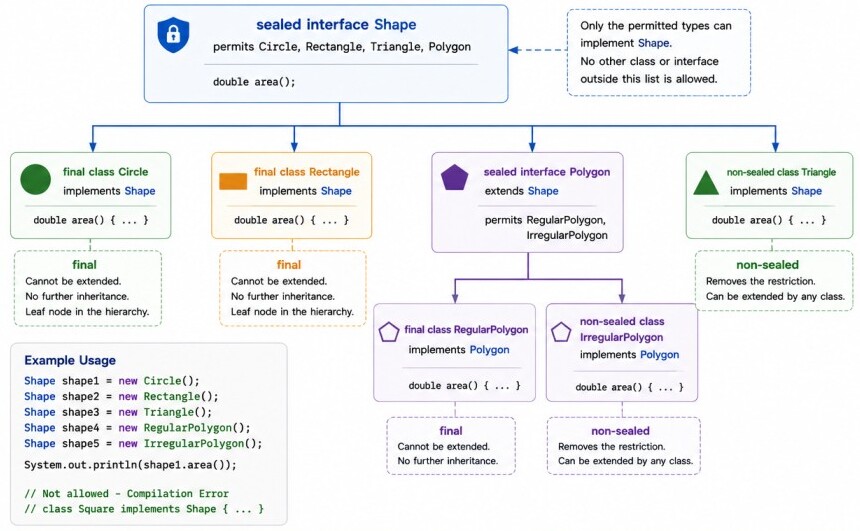
Java 17 introduced sealed interfaces, allowing developers to explicitly control which classes or interfaces are permitted to implement an interface.Before sealed interfaces, any class could implement a public interface.
While this flexibility is often desirable, there are situations where an API should support only a fixed set of implementations. Sealed interfaces make this possible by restricting the inheritance hierarchy.
A sealed interface declares its permitted implementations using the permits clause.
public sealed interface Shape
        permits Circle, Rectangle, Triangle {
    double area();
}public final class Circle implements Shape {
@Override
public double area() {
return 100;
}
}
public final class Rectangle implements Shape {
@Override
public double area() {
return 200;
}
}
public final class Triangle implements Shape {
@Override
public double area() {
return 150;
}
}Permitted Subclasses
Every permitted implementation of a sealed interface must explicitly declare one of the following modifiers.| Modifier | Meaning |
|---|---|
| final | No further inheritance is allowed. |
| sealed | Further inheritance is allowed, but only for explicitly permitted subclasses. |
| non-sealed | Removes the restriction, allowing unrestricted inheritance. |
Abstract Classes with Constructors
Although an abstract class cannot be instantiated directly, it can define one or more constructors.These constructors are invoked whenever a concrete subclass is created, making them ideal for initializing common state shared by all subclasses.
public abstract class Vehicle {
    protected String registrationNumber;

    public Vehicle(String registrationNumber) {
        this.registrationNumber = registrationNumber;
    }
}public class Car extends Vehicle {
public Car(String registrationNumber) {
super(registrationNumber);
}
}Vehicle vehicle = new Vehicle("UK07AB1234"); // Compilation ErrorVehicle vehicle = new Car("UK07AB1234"); Template Method Pattern
One of the most common uses of abstract classes is implementing the Template Method Pattern.The Template Method Pattern defines the overall algorithm in a concrete method while allowing subclasses to customize specific steps.
This ensures that the sequence of operations remains consistent while permitting variation where required. Consider a simple document generation framework.
public abstract class DocumentGenerator {
    public final void generate() {
        readData();
        processData();
        saveDocument();
    }

    protected void readData() {
        System.out.println("Reading data...");
    }

    protected abstract void processData();

    protected void saveDocument() {
        System.out.println("Saving document...");
    }
}public class PdfGenerator extends DocumentGenerator {
@Override
protected void processData() {
System.out.println("Generating PDF...");
}
}DocumentGenerator generator = new PdfGenerator();
generator.generate();Reading data...
Generating PDF...
Saving document...Final Notes
Interfaces define contracts that enable loose coupling, polymorphism, and multiple inheritance of type, making them ideal for APIs, service layers, plugin architectures, and dependency injection.Modern enhancements such as default methods, static methods, private methods, and sealed interfaces have made interfaces significantly more expressive while preserving backward compatibility.
Abstract classes complement interfaces by providing shared state, constructors, and reusable implementations for closely related classes.
They are particularly well suited for implementing common workflows, enforcing invariants, and applying design patterns such as the Template Method Pattern.