BlockingQueue works, understand its most common implementations, and learn why it has become the preferred solution for the Producer-Consumer pattern in modern Java applications.
Limitations of wait() & notify()
Althoughwait() and notify() provide powerful synchronization primitives, building reliable concurrent applications with them requires considerable care.
Every shared resource must be protected by synchronized blocks, waiting conditions must be checked repeatedly, and notifications must be issued correctly to prevent threads from waiting forever.
Consider the Producer-Consumer example from the previous chapter.
while (!available) {
    wait();
}The thread must own the monitor before calling
wait(), the condition must be checked using a while loop instead of an if statement, and another thread must eventually invoke notify() or notifyAll() after modifying the shared state.
Forgetting any of these details can introduce subtle concurrency bugs that are often difficult to reproduce and debug.
As applications grow larger, manually coordinating dozens of producer and consumer threads quickly becomes complicated.
Developers spend more time reasoning about synchronization than implementing business logic.
The
BlockingQueue interface eliminates much of this complexity by encapsulating synchronization inside a reusable, thread-safe data structure.
What is a BlockingQueue?
A BlockingQueue is a thread-safe queue designed specifically for concurrent applications.It allows multiple producer threads to insert elements while multiple consumer threads remove elements safely without requiring explicit synchronization.
Its defining characteristic is that queue operations automatically block whenever progress cannot be made.
If a producer attempts to insert an element into a full queue, the producer thread automatically waits until space becomes available.
Similarly, if a consumer attempts to remove an element from an empty queue, the consumer thread automatically waits until another thread inserts an element.
This behavior makes
BlockingQueue an ideal solution for implementing the Producer-Consumer pattern.
The overall architecture is illustrated below.
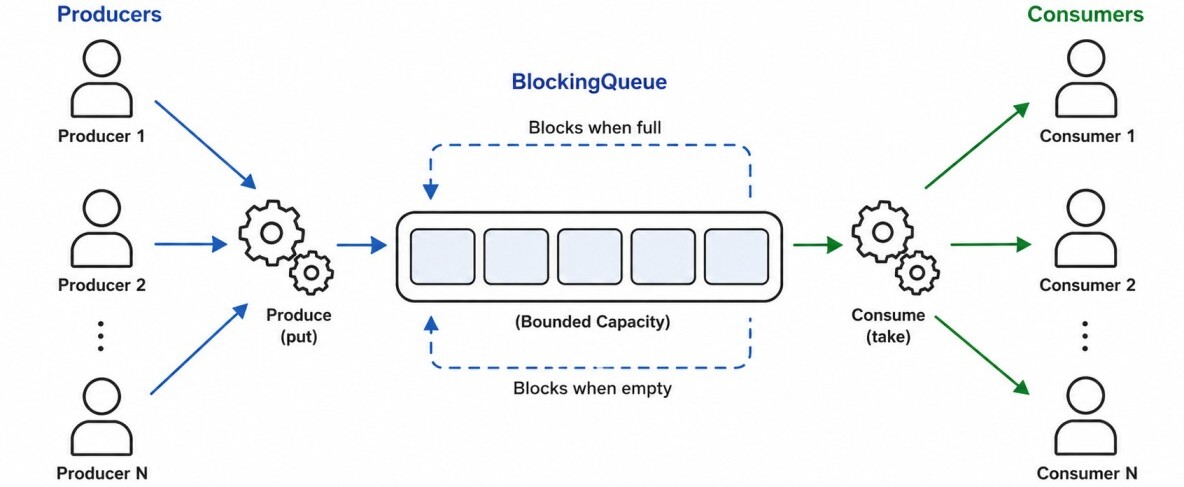
wait() and notify(), producers and consumers never communicate directly.
Instead, both interact with the queue, which manages synchronization internally.
The BlockingQueue Interface
TheBlockingQueue interface is part of the java.util.concurrent package.
public interface BlockingQueue<E> extends Queue<E> Queue interface, it supports familiar queue operations while adding methods specifically designed for concurrent programming.Unlike ordinary collections such as
ArrayList or LinkedList, every implementation of BlockingQueue is thread-safe and internally coordinates producers and consumers.
Common Operations
TheBlockingQueue interface provides several methods for inserting, removing, and inspecting elements.
Each method behaves differently depending on whether the queue is full or empty, allowing developers to choose between blocking and non-blocking behavior.
put()
Theput() method inserts an element into the queue. If the queue is full, the calling thread automatically waits until space becomes available.
queue.put(100);take()
Thetake() method removes and returns the head of the queue. If the queue is empty, the calling thread waits until an element becomes available.
Integer value = queue.take();offer()
Theoffer() method attempts to insert an element without blocking.
boolean added = queue.offer(100);true. If the queue is full, it immediately returns false instead of waiting.
poll()
Thepoll() method attempts to remove and return the head of the queue without waiting.
Integer value = queue.poll();null instead of blocking.
NOTE: Timed variants of offer() and poll() wait for a specified duration before giving up, providing a balance between blocking and non-blocking behavior.
queue.offer(100, 5, TimeUnit.SECONDS);
queue.poll(5, TimeUnit.SECONDS);
peek()
Thepeek() method returns the head of the queue without removing it.
Integer value = queue.peek();null. Unlike take() and poll(), the element remains in the queue after the call completes.
remainingCapacity()
TheremainingCapacity() method returns the number of additional elements that can be inserted into the queue without blocking.
int remaining = queue.remainingCapacity();ArrayBlockingQueue, the returned value decreases as elements are added and increases as elements are removed.
For unbounded queues, it typically returns Integer.MAX_VALUE minus the current number of elements.
drainTo()
ThedrainTo() method removes all available elements from the queue and transfers them to another collection in a single operation.
List<Integer> batch = new ArrayList<>();
queue.drainTo(batch);take() or poll() calls.
Implementations
Java provides several implementations of theBlockingQueue interface, each optimized for different scenarios. The most commonly used implementations are:
ArrayBlockingQueue
AnArrayBlockingQueue stores its elements in a fixed-size circular array. Its capacity is specified when the queue is created and cannot be changed later.
import java.util.concurrent.ArrayBlockingQueue;
import java.util.concurrent.BlockingQueue;

BlockingQueue<Integer> queue = new ArrayBlockingQueue<>(5);Because the queue has a fixed capacity, it naturally limits memory usage and provides predictable behavior under heavy workloads.
This makes
ArrayBlockingQueue particularly suitable for systems where resource consumption must remain bounded.
An
ArrayBlockingQueue follows the First-In, First-Out (FIFO) principle. The first element inserted into the queue is always the first element removed.Unlike manually synchronized collections, an
ArrayBlockingQueue performs all synchronization internally.
Multiple producer and consumer threads can safely access the queue concurrently without surrounding queue operations with synchronized blocks.
Producers typically insert elements using
put(), while consumers retrieve them using take(). These operations are covered in detail later.
LinkedBlockingQueue
WhileArrayBlockingQueue stores elements in a fixed-size array, LinkedBlockingQueue stores its elements in a linked list.
Unlike an array-based implementation, its capacity can grow dynamically, making it well suited for applications where the number of queued elements is difficult to predict.
A
LinkedBlockingQueue can be created with either a fixed capacity or the default capacity.
import java.util.concurrent.BlockingQueue;
import java.util.concurrent.LinkedBlockingQueue;

BlockingQueue<Integer> queue = new LinkedBlockingQueue<>();If producers consistently outpace consumers, an unbounded queue may eventually lead to excessive memory consumption or an OutOfMemoryError.
If a bounded queue is preferred, the capacity can be specified explicitly.
BlockingQueue<Integer> queue = new LinkedBlockingQueue<>(100); ArrayBlockingQueue, it follows the FIFO (First-In, First-Out) principle and automatically blocks producers when the queue reaches its capacity and consumers when the queue becomes empty.Internally,
LinkedBlockingQueue maintains a linked list of nodes rather than a fixed-size array.
Because insertion and removal operations use separate internal locks,
LinkedBlockingQueue often provides better throughput than ArrayBlockingQueue when producers and consumers operate concurrently.
The trade-off is higher memory usage because each element requires an additional node object.
Producer-Consumer Example
Using aBlockingQueue, the Producer-Consumer problem becomes remarkably simple because synchronization is handled internally.
import java.util.concurrent.ArrayBlockingQueue;
import java.util.concurrent.BlockingQueue;

public class ProducerConsumerDemo {
    public static void main(String[] args) {
        BlockingQueue<Integer> queue = new ArrayBlockingQueue<>(5);

        Thread producer = new Thread(() -> {
            try {
                for (int i = 1; i <= 10; i++) {
                    queue.put(i);
                    System.out.println("Produced: " + i);
                }
            } catch (InterruptedException e) {
                Thread.currentThread().interrupt();
            }
        });

        Thread consumer = new Thread(() -> {
            try {
                while (true) {
                    Integer value = queue.take();
                    System.out.println("Consumed: " + value);
                }
            } catch (InterruptedException e) {
                Thread.currentThread().interrupt();
            }
        });

        producer.start();
        consumer.start();
    }
}Produced: 1
Consumed: 1
Produced: 2
Consumed: 2
Produced: 3
Consumed: 3
...Conclusion
TheBlockingQueue interface provides a modern, high-level solution to the Producer-Consumer problem by encapsulating synchronization within a thread-safe queue.
By providing built-in blocking behavior, thread safety, and efficient producer-consumer coordination, BlockingQueue eliminates much of the complexity associated with low-level synchronization.
As a result, it has become the preferred building block for producer-consumer workflows, task processing pipelines, and many other concurrent applications in modern Java.