It provides a rich set of interfaces, implementations, and algorithms that eliminate the need to build custom data structures for common use cases.
Collection Hierarchy
The Collections Framework is organized around a small set of core interfaces.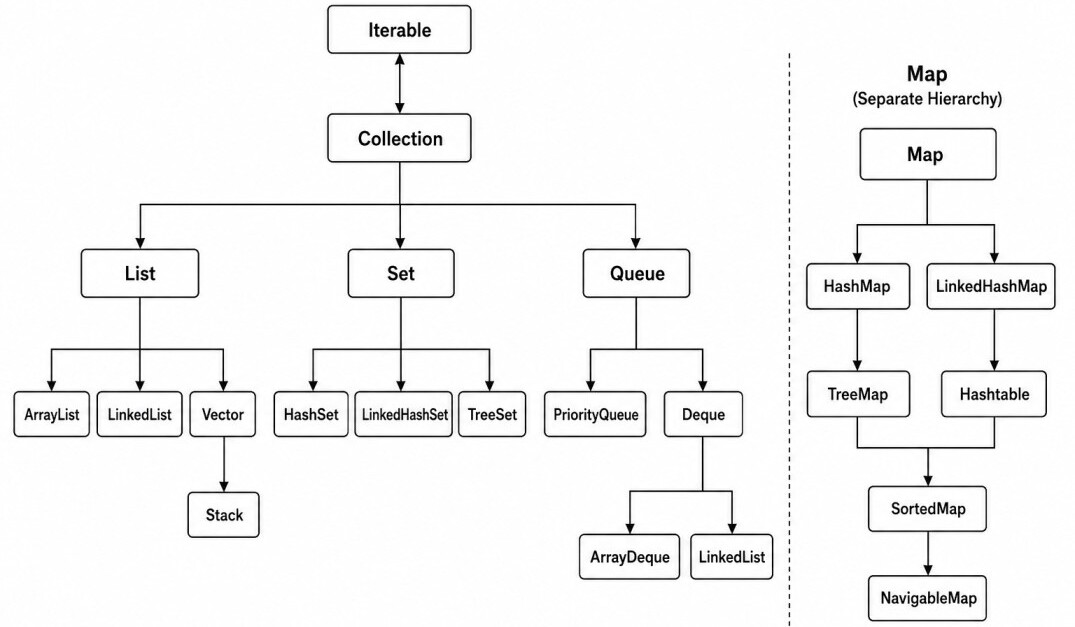
Collection interface because it stores key-value pairs rather than individual elements.
Collection Interface
The Collection interface defines common operations supported by most collections.Collection<String> names = new ArrayList<>();
names.add("John");
names.remove("John");
names.contains("John");
names.size();
names.isEmpty();
names.clear();List
A List represents an ordered collection that allows duplicate elements. Implementations include:- ArrayList
- LinkedList
- Vector
Lists preserve insertion order and provide positional access.
ArrayList
ArrayList is backed by a dynamically resizable array.List<String> names = new ArrayList<>();
names.add("Alice");
names.add("Bob");
System.out.println(names.get(0));- Maintains insertion order.
- Allows duplicates.
- Allows null elements.
- Provides fast random access.
- Insertion or deletion in the middle requires shifting elements.
Average time complexity:
- Access: O(1)
- Search: O(n)
- Insert at end: O(1) amortized
- Insert/Delete middle: O(n)
LinkedList
LinkedList is implemented as a doubly linked list.LinkedList<Integer> list = new LinkedList<>();
list.addFirst(10);
list.addLast(20);- Maintains insertion order.
- Allows duplicates.
- Efficient insertion and deletion at both ends.
- Sequential access.
- Random access is inefficient.
Average time complexity:
- Access: O(n)
- Insert/Delete beginning: O(1)
- Insert/Delete middle: O(n)
ArrayList vs LinkedList
Choose ArrayList when reads significantly outnumber modifications and frequent indexed access is required.Choose LinkedList when insertions and deletions occur primarily at the beginning or end of the collection. For most applications, ArrayList remains the preferred choice due to better cache locality and lower memory overhead.
Vector
Vector is a legacy synchronized implementation similar to ArrayList.Vector<Integer> vector = new Vector<>();Stack
Stack is a legacy class extending Vector.Stack<Integer> stack = new Stack<>();
stack.push(10);
stack.pop();
stack.peek();ArrayDeque.
Set
A Set stores unique elements. Implementations include:- HashSet
- LinkedHashSet
- TreeSet
Duplicates are automatically rejected.
HashSet
HashSet stores elements using a hash table.Set<String> cities = new HashSet<>();
cities.add("Delhi");
cities.add("Mumbai");
cities.add("Delhi");- No duplicate elements.
- No ordering guarantee.
- Allows one null element.
Average complexity:
- Add: O(1)
- Remove: O(1)
- Contains: O(1)
Performance depends on good implementations of
hashCode() and equals().
LinkedHashSet
LinkedHashSet extends HashSet by maintaining insertion order.Set<Integer> values = new LinkedHashSet<>();TreeSet
TreeSet stores elements in sorted order.TreeSet<Integer> numbers = new TreeSet<>();
numbers.add(30);
numbers.add(10);
numbers.add(20);[10, 20, 30]Average complexity:
- Insert: O(log n)
- Remove: O(log n)
- Search: O(log n)
Queue
A Queue generally follows the FIFO principle. Common implementations include:- LinkedList
- PriorityQueue
- ArrayDeque
PriorityQueue
PriorityQueue orders elements according to natural ordering or a comparator.PriorityQueue<Integer> queue = new PriorityQueue<>();
queue.offer(30);
queue.offer(10);
queue.offer(20);
System.out.println(queue.poll());10Deque
Deque supports insertion and removal from both ends. The preferred implementation is ArrayDeque.Deque<Integer> deque = new ArrayDeque<>();
deque.addFirst(10);
deque.addLast(20);
deque.removeFirst();
deque.removeLast();Map
A Map stores unique keys associated with values. Implementations include:- HashMap
- LinkedHashMap
- TreeMap
- Hashtable
Maps do not implement the Collection interface.
HashMap
HashMap is the most commonly used map implementation.Map<Integer, String> employees = new HashMap<>();
employees.put(1, "John");
employees.put(2, "Alice");
System.out.println(employees.get(1));- Unique keys.
- Allows one null key.
- Allows multiple null values.
- No ordering guarantee.
Average complexity:
- Put: O(1)
- Get: O(1)
- Remove: O(1)
Since Java 8, buckets containing many collisions are converted into balanced trees to improve worst-case lookup performance.
LinkedHashMap
LinkedHashMap preserves insertion order.Map<Integer, String> map = new LinkedHashMap<>();TreeMap
TreeMap stores entries in sorted key order. Internally uses a Red-Black Tree.TreeMap<Integer, String> map = new TreeMap<>();- Put: O(log n)
- Get: O(log n)
- Remove: O(log n)
Null keys are not allowed.
Hashtable
Hashtable is a legacy synchronized map.Hashtable<Integer, String> table = new Hashtable<>();Comparable
Comparable defines the natural ordering of objects.class Employee implements Comparable<Employee> {
int id;
@Override
public int compareTo(Employee other) {
return Integer.compare(id, other.id);
}
}Comparator
Comparator provides external sorting logic.Comparator<Employee> comparator =
Comparator.comparing(Employee::getName);Sorting Collections
Collections can be sorted using the Collections utility class.Collections.sort(numbers);
Collections.sort(employees, comparator);employees.sort(comparator);Iterator
An Iterator provides sequential access to collection elements.Iterator<String> iterator = names.iterator();
while (iterator.hasNext()) {
System.out.println(iterator.next());
}iterator.remove();ListIterator
ListIterator extends Iterator. It supports:- Forward traversal.
- Backward traversal.
- Element replacement.
- Insertion.
- Removal.
It is available only for List implementations.
Fail-Fast Iterators
Most collection iterators are fail-fast. Structural modification outside the iterator causes ConcurrentModificationException.for (String name : names) {
names.remove(name);
}remove() method instead.
Immutable Collections
Java provides immutable collection factories.List<Integer> numbers = List.of(1, 2, 3);
Set<String> names = Set.of("A", "B");
Map<Integer, String> map = Map.of(
1, "One",
2, "Two"
);Collections Utility Class
The Collections utility class provides algorithms for collections.Collections.sort(list);
Collections.reverse(list);
Collections.shuffle(list);
Collections.binarySearch(list, value);
Collections.min(list);
Collections.max(list);
Collections.frequency(list, value);
Collections.unmodifiableList(list);
Choosing the Right Collection
- Use ArrayList for most ordered collections with frequent reads.- Use LinkedList only when frequent insertions or removals occur at the ends.
- Use HashSet for fast uniqueness checks.
- Use LinkedHashSet when insertion order matters.
- Use TreeSet when sorted data is required.
- Use HashMap for fast key-value lookups.
- Use LinkedHashMap when predictable iteration order or LRU behavior is needed.
- Use TreeMap when sorted keys are required.
- Use PriorityQueue for priority-based processing.
- Use ArrayDeque for stack or queue implementations.