Although commonly associated with microservices, Polyglot Persistence can also be applied within a monolithic application when different modules have significantly different storage requirements.
Why Do We Need Polyglot Persistence?
Consider an e-commerce application.Order processing requires ACID transactions, the product catalog benefits from a flexible document model, product search requires fast full-text indexing, and analytics needs high-performance aggregation over large volumes of data.
Using a single database for every workload forces compromises because no database is optimized for every use case.
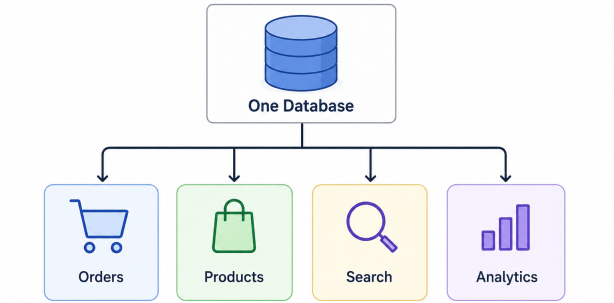
Polyglot Persistence addresses this by allowing each service or workload to use the database technology best suited to its requirements.
Example Architecture
The following architecture shows how a microservices application uses different databases for different workloads.Rather than forcing every service to use the same database technology, Polyglot Persistence allows each service to choose the database that best matches its workload.
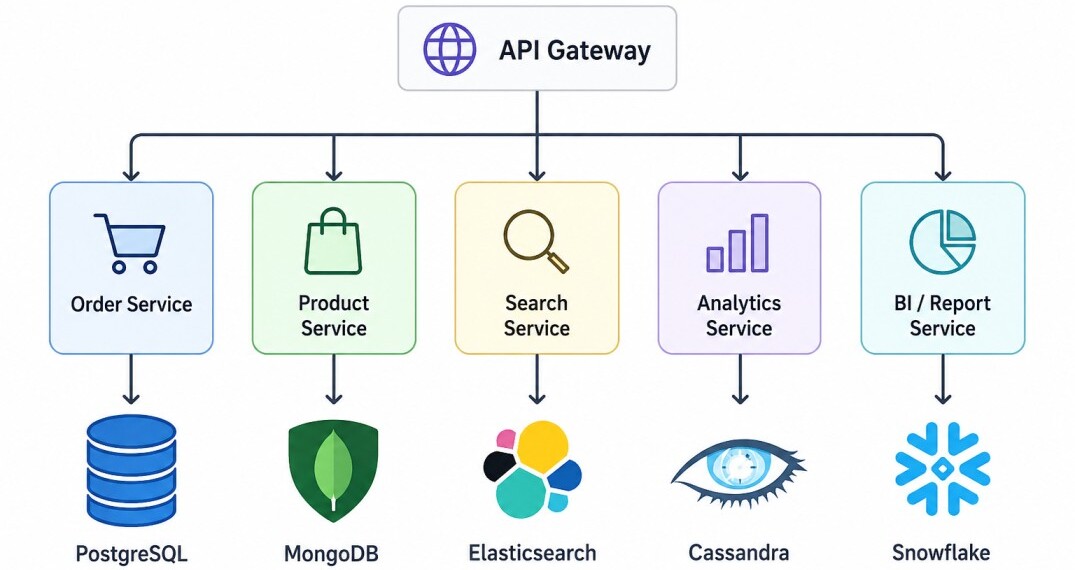
Cassandra handles high-volume operational analytics and time-series data, while Snowflake supports business intelligence, reporting, and large-scale analytical queries.
Relational Databases
Relational databases such as PostgreSQL, MySQL, and Oracle are well suited for transactional workloads that require strong consistency and ACID transactions.A typical relational schema for order processing is shown below.
+-----------+          +---------------+
|  Orders   |          |  Order_Items  |
+-----------+          +---------------+
| order_id  |<--1:N--->| order_id      |
| customer  |          | product_id    |
| status    |          | quantity      |
+-----------+          +---------------+
      |
     1:1
      |
      v
+-----------+
| Payments  |
+-----------+
| order_id  |
| amount    |
| status    |
+-----------+
Relational databases provide features such as transactions, foreign keys, joins, and constraints to ensure data integrity.
For example, when a customer places an order, the application may insert the order, save the order items, and create a payment record within a single transaction.
@Transactional
public void createOrder(CreateOrderRequest request) {
    orderRepository.save(order);
    orderItemRepository.saveAll(items);
    paymentRepository.save(payment);
}
This makes relational databases the preferred choice for business-critical transactional systems.
Document Databases
Document databases such as MongoDB store data as flexible JSON-like documents instead of rows and columns.They are well suited for applications where records may have different structures or evolve frequently without requiring schema changes.
For example, an e-commerce application may store different types of products in the same collection.
{
  "_id": 101,
  "name": "Laptop",
  "brand": "Dell",
  "ram": "16 GB",
  "ssd": "512 GB",
  "price": 89999
}
{
  "_id": 102,
  "name": "Television",
  "brand": "Samsung",
  "screenSize": "65 inch",
  "resolution": "4K",
  "price": 74999
}
{
  "_id": 103,
  "name": "Refrigerator",
  "brand": "LG",
  "capacity": "420 L",
  "doorType": "Double Door",
  "price": 55999
}
Suppose the Product Service stores products in MongoDB.
@Document(collection = "products")
public class Product {

    @Id
    private Long id;
    private String name;
    private String brand;
    private Map attributes;
    private BigDecimal price;
}
Product product = new Product();

product.setId(101L);
product.setName("Laptop");
product.setBrand("Dell");
product.setPrice(BigDecimal.valueOf(89999));

product.setAttributes(
    Map.of(
        "ram", "16 GB",
        "ssd", "512 GB"
    )
);

productRepository.save(product);
This flexibility makes document databases well suited for product catalogs, user profiles, content management systems, and other applications with evolving or semi-structured data.
Search Engines
Search engines such as Elasticsearch are optimized for full-text search, filtering, relevance scoring, and aggregations.Instead of executing expensive SQL LIKE queries, applications index searchable data into Elasticsearch.
{
  "id": 101,
  "name": "Wireless Bluetooth Headphones",
  "brand": "Sony",
  "category": "Electronics",
  "price": 12999,
  "description": "Noise cancelling wireless headphones"
}
@Document(indexName = "products")
public class ProductDocument {

    @Id
    private Long id;

    private String name;
    private String brand;
    private String category;
    private BigDecimal price;
    private String description;
}
List products =
        repository.findByNameContaining(
                "wireless headphones"
        );
It provides fast full-text search, autocomplete, typo tolerance, relevance ranking, filtering, and aggregations, making it well suited for product catalogs, document search, and log analytics.
Wide-Column Databases
Wide-column databases such as Apache Cassandra are designed for extremely high write throughput, horizontal scalability, and high availability.They are commonly used for time-series data, IoT applications, logging, telemetry, and analytics, where applications continuously generate large volumes of data.
For example, an analytics service may record user activity for dashboard reporting.
CREATE TABLE user_activity (
    user_id UUID,
    event_date DATE,
    event_time TIMESTAMP,
    event_type TEXT,
    page TEXT,
    PRIMARY KEY ((user_id, event_date), event_time)
) WITH CLUSTERING ORDER BY (event_time DESC);
The application stores each user activity as a new row.
@Table("user_activity")
public class UserActivity {

    @PrimaryKey
    private UserActivityKey key;

    private String eventType;
    private String page;
}
UserActivity activity = new UserActivity();
activity.setKey(
    new UserActivityKey(
        userId,
        LocalDate.now(),
        Instant.now()
    )
);
activity.setEventType("PRODUCT_VIEW");
activity.setPage("/products/101");

repository.save(activity);
This makes it well suited for logging, telemetry, analytics, and other write-intensive workloads.
Apache Cassandra is classified as a Wide-Column Database (also called a Column Family Database), not a Columnar Database.
Database Type Examples Optimized For Wide-Column Database (Column Family) Cassandra, HBase, ScyllaDB High write throughput, horizontal scalability, distributed storage Columnar Database ClickHouse, Apache Druid, Amazon Redshift, Snowflake, Vertica OLAP, analytics, aggregations, and scanning billions of rows
Columnar Databases
Columnar databases such as Snowflake, Amazon Redshift, and ClickHouse are optimized for OLAP (Online Analytical Processing), large-scale aggregations, and reporting.Unlike transactional databases, they store data by columns rather than rows, allowing analytical queries to read only the required columns.
For example, a sales analytics table may contain millions or billions of records.
+------------+------------+-----------+------------+---------+
| order_id   | region     | product   | order_date | amount  |
+------------+------------+-----------+------------+---------+
| 101        | US         | Laptop    | 2026-07-01 | 900.00  |
| 102        | India      | Phone     | 2026-07-01 | 500.00  |
| 103        | Germany    | Monitor   | 2026-07-02 | 300.00  |
+------------+------------+-----------+------------+---------+
SELECT region,
       SUM(amount) AS total_sales
FROM sales
WHERE order_date >= '2026-07-01'
GROUP BY region;
By reading only the required columns, significantly less data is scanned, resulting in much faster aggregations over very large datasets.
Suppose the Analytics Service queries Snowflake using Spring Boot.
List summaries =
        jdbcTemplate.query(
                sql,
                new SalesSummaryRowMapper()
        );
Caching Layer
Applications frequently use an in-memory cache such as Redis alongside their primary databases to reduce database load and improve response times.Instead of querying the database for every request, the application first checks whether the requested data is already available in the cache.
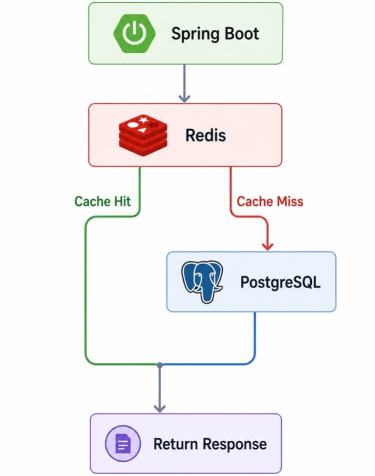
@Cacheable("products")
public Product getProduct(Long id) {
    return productRepository.findById(id)
            .orElseThrow();
}
Because Redis stores data entirely in memory, it provides extremely low-latency access, making it well suited for frequently accessed data such as product catalogs, user sessions, API responses, and application configuration.
Data Synchronization
When an application uses multiple databases, the same business data often needs to be available in more than one system.For example, when a new product is created in PostgreSQL, it should also be indexed in Elasticsearch so that customers can search for it.
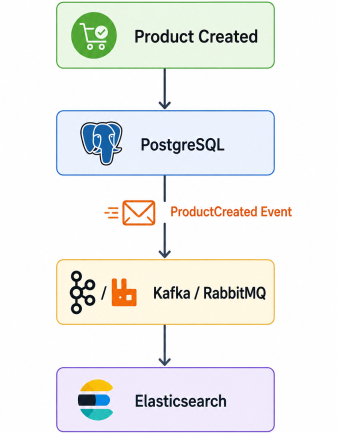
productRepository.save(product);
kafkaTemplate.send(
        "products",
        new ProductCreatedEvent(product)
);
@KafkaListener(topics = "products")
public void consume(ProductCreatedEvent event) {
    searchRepository.save(
            ProductDocument.from(event)
    );
}
The same approach can be used to synchronize data with Redis, MongoDB, Apache Cassandra, or other specialized data stores.
Consistency Considerations
Because multiple databases may contain copies of the same business data, Polyglot Persistence commonly relies on asynchronous messaging to keep them synchronized.
As a result, different databases may temporarily contain different versions of the same data until synchronization completes.
This trade-off, known as eventual consistency, improves scalability while avoiding distributed transactions across heterogeneous databases.
Summary
Polyglot Persistence allows applications to combine multiple database technologies, selecting the most appropriate database for each workload rather than forcing every use case into a single database.Each database is chosen according to its strengths—for example, relational databases for transactions, document databases for flexible schemas, search engines for full-text search, wide-column databases for large-scale analytics, and in-memory caches for low-latency data access.
Although Polyglot Persistence increases operational complexity, it provides the flexibility and scalability required by modern Spring Boot microservices and large distributed systems where different workloads have fundamentally different storage requirements.