The API Gateway pattern provides a single entry point for client requests.
It routes requests to the appropriate services while handling common concerns such as authentication, authorization, rate limiting, load balancing, caching, and request routing.
What Is the API Gateway Pattern?
The API Gateway is a dedicated service that acts as the single entry point between clients and backend microservices.Instead of communicating directly with individual services, clients send all requests to the gateway. The gateway then routes each request to the appropriate service while handling cross-cutting concerns.
Unlike a reverse proxy, which primarily forwards requests, an API Gateway can orchestrate the entire request flow.
As a result, clients don't need to know the location, protocol, API version, authentication mechanism, or network topology of the backend services.
Responsibilities of an API Gateway
An API Gateway acts as the central entry point for client requests and provides several common capabilities that would otherwise need to be implemented by every backend service.1) It performs authentication and authorization, ensuring only authenticated and authorized clients can access protected APIs.
2) It performs request routing, forwarding each request to the appropriate backend service based on the request path, HTTP method, headers, or routing rules.
3) It can enforce rate limiting to protect backend services from excessive traffic and perform TLS termination, allowing clients to establish secure HTTPS connections without requiring every microservice to manage SSL/TLS certificates.
4) Many API Gateways also provide response caching to reduce latency and backend load, especially for frequently requested data.
6) Some gateways support protocol translation, enabling clients to communicate using REST or GraphQL while backend services communicate using gRPC or messaging systems.
Finally, an API Gateway simplifies API versioning and traffic management, allowing multiple API versions 7) to coexist and enabling deployment strategies such as blue-green and canary deployments.
Example: E-Commerce Checkout on AWS
Consider an e-commerce application deployed on AWS. Mobile and web applications communicate with Amazon API Gateway, while backend microservices run on Amazon EKS.Services communicate internally using gRPC, and business events are published to Amazon EventBridge.
1) When a customer places an order by calling POST /api/v1/orders, the API Gateway first validates the customer's JWT token using Amazon Cognito. If authentication fails, the request is rejected immediately. Otherwise, the gateway routes the request to the Order Service running on Amazon EKS.
2) During flash sales, the gateway applies throttling rules. For example, it may allow only 100 requests per second from a single client. Requests within the configured limit are forwarded to the Order Service, while additional requests receive an HTTP 429 (Too Many Requests) response without reaching any backend service.
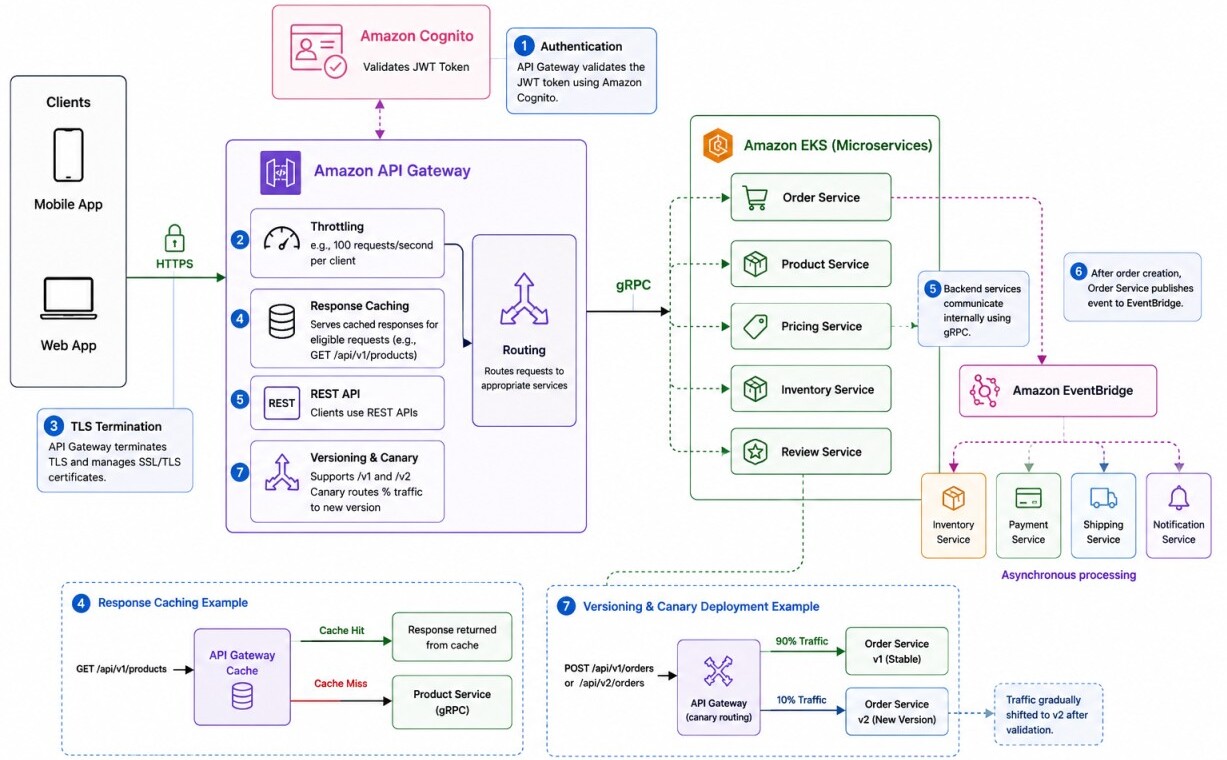
4) When customers browse products, requests to GET /api/v1/products can be served directly from the gateway's response cache, reducing latency and avoiding unnecessary calls to the Product Service.
5) Clients communicate with the gateway using REST APIs, while backend services communicate internally using gRPC.
6) After an order is successfully created, the Order Service publishes an event to Amazon EventBridge, allowing the Inventory, Payment, Shipping, and Notification services to process the order asynchronously.
7) When a new version of the Order Service is deployed, both /api/v1/orders and /api/v2/orders can remain available. Using canary deployment, the API Gateway initially routes a small percentage of traffic to the new version and gradually shifts all traffic after the deployment is validated.
BFF (Backend for Frontend)
Different clients often require different data. A Backend for Frontend (BFF) provides client-specific APIs optimized for a particular frontend, such as a web application, mobile app, or smart TV.The API Gateway remains the single entry point for all client requests, handling responsibilities such as authentication, authorization, rate limiting, and request routing. After validating a request, it forwards it to the appropriate BFF.
For example, when a customer opens a Product Details page in a mobile app, the Mobile BFF retrieves product information, pricing, inventory, and reviews from multiple backend services and combines them into a single response optimized for the mobile UI.
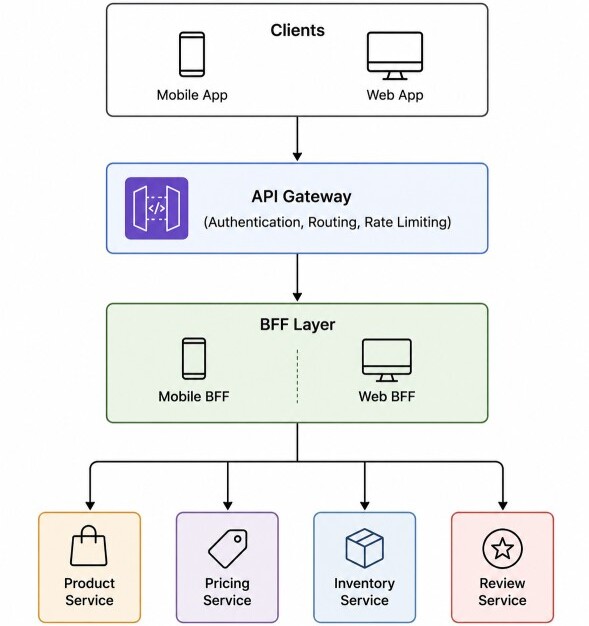
Backend services continue to expose reusable APIs using REST, gRPC, or messaging, while each BFF shapes the data according to the needs of its frontend.
Modern API Gateway Solutions
Rather than building common API gateway capabilities from scratch, organizations typically adopt mature gateway platforms that integrate seamlessly with their infrastructure and deployment models.The choice of gateway depends on the architecture. Some solutions are ideal for traditional microservices, some for Kubernetes, some for serverless applications, while others focus on enterprise API management and governance.
1. Kong
Kong is one of the most popular open-source API gateways for microservice-based applications.Built on top of NGINX, it combines high performance with a rich plugin ecosystem, making it easy to implement common gateway features without writing custom code.
A typical deployment places Kong between clients and backend services. Every incoming request passes through Kong, where plugins can authenticate the user, validate JWT tokens, enforce rate limits, log requests, transform headers, and finally route the request to the appropriate microservice.
Kong is an excellent choice when building cloud-native applications, especially on Kubernetes.
It supports both traditional deployments and Kubernetes Ingress, integrates with service discovery, and can be extended through custom plugins written in Lua or Go.
Large e-commerce platforms often use Kong to expose product, inventory, payment, and order APIs while applying the same authentication, logging, and traffic policies across all services.
2. NGINX
NGINX is a high-performance web server and reverse proxy that is frequently used as a lightweight API gateway.In fact, several commercial and open-source gateway products are built on top of NGINX because of its efficient event-driven architecture.
Unlike dedicated API management platforms, NGINX primarily focuses on request routing, load balancing, SSL termination, caching, and reverse proxying.
These capabilities are configured through NGINX configuration files, making it simple to deploy and extremely fast. A common implementation places NGINX at the edge of the infrastructure.
Client requests first reach NGINX, which terminates HTTPS connections, forwards requests to the appropriate backend service, balances traffic across multiple service instances, and optionally caches frequently requested responses such as product catalogs or static resources.
NGINX is a great choice for organizations that need a fast, reliable edge proxy without requiring advanced API lifecycle management or a large plugin ecosystem.
3. AWS API Gateway
AWS API Gateway is a fully managed gateway service designed for applications hosted on AWS.Unlike Kong or NGINX, there are no servers or clusters to manage, as AWS automatically handles scaling, availability, and infrastructure maintenance.
It integrates natively with AWS services such as Lambda, SQS, DynamoDB, Step Functions, and Cognito.
Authentication, authorization, API keys, throttling, caching, monitoring, and request validation are built into the platform.
In a typical serverless application, API Gateway receives the client request, validates authentication, applies throttling policies, invokes a Lambda function or another AWS service, and returns the response to the client.
Since billing is based on the number of requests, it is particularly attractive for applications with unpredictable traffic.
AWS API Gateway is the preferred choice when most backend services already run on AWS and the architecture heavily relies on serverless computing.
4. Apigee
Apigee is an enterprise API management platform that extends well beyond traditional request routing.It focuses on the complete API lifecycle, including API design, publishing, security, analytics, developer portals, version management, and monetization.
Organizations typically place Apigee in front of their APIs to expose them to external developers, partners, or customers.
Besides routing requests, Apigee applies security policies, validates OAuth tokens, enforces quotas, tracks API usage, generates analytics dashboards, and manages API versions throughout their lifecycle.
Apigee is commonly adopted by banks, telecom companies, healthcare providers, and large retailers that expose APIs to third-party partners and require centralized governance, compliance, detailed analytics, and subscription management.
If the primary requirement is managing APIs as products rather than simply routing traffic, Apigee is often a better fit than lightweight gateways.
5. Istio Ingress Gateway
Istio is a service mesh, and its Ingress Gateway serves as the external entry point into a Kubernetes cluster.Unlike standalone API gateways, Istio also manages communication between internal microservices using Envoy sidecar proxies.
A typical implementation routes incoming requests through the Istio Ingress Gateway, which applies authentication, authorization, and routing rules before forwarding traffic to the appropriate service.
Once inside the cluster, every service-to-service request is also managed by Istio, enabling automatic mTLS encryption, retries, circuit breakers, traffic shaping, and observability.
Istio excels in large Kubernetes environments where hundreds of microservices communicate with each other.
It enables advanced deployment strategies such as canary releases, blue-green deployments, and traffic shadowing without requiring changes to application code.
While Istio can expose APIs externally through its Ingress Gateway, its greatest strength lies in managing secure and reliable communication within complex Kubernetes-based microservice architectures.
Conclusion
The API Gateway Pattern is foundational in building robust, evolvable, secure distributed systems.It provides a unified access layer for clients, abstracts backend complexity, improves performance, and enforces consistent operational policies.
