The system should support billions of videos, millions of concurrent viewers, adaptive video streaming, and low-latency content delivery.
Requirements
Functional Requirements
The YouTube system should satisfy the following functional requirements.1. Allow users to upload videos.
2. Allow users to watch videos.
3. Allow users to search for videos.
4. Allow users to like and comment on videos.
5. Allow users to subscribe to channels.
6. Support multiple video resolutions.
7. Provide personalized video recommendations.
8. Track video views.
9. Send notifications for subscribed channels.
Non-Functional Requirements
The system should also satisfy the following non-functional requirements.1. Low latency.
2. High availability.
3. Horizontal scalability.
4. High throughput.
5. Fault tolerance.
6. Low-latency global video delivery.
Capacity Estimation
The following estimation uses reasonable assumptions for a large-scale video-sharing platform.1. Daily Active Users
Assume the platform has approximately 100 million Daily Active Users (DAU). If each active user watches approximately 5 videos per day, the system would handle:Daily Video Views
= 100 million users × 5 videos
= 500 million video views/day
Assuming users spend an average of 30 minutes per day watching videos, the platform would need to continuously serve a very large amount of video content through the CDN.
2. Monthly Active Users
Assume approximately 500 million Monthly Active Users (MAU). The relationship between DAU and MAU can be estimated as:DAU = 100 million
MAU = 500 million
DAU / MAU = 20%
The MAU number is important for estimating persistent user data such as profiles, subscriptions, watch history, preferences, recommendations, and other user-related metadata.
3. Throughput – Read & Write
The platform is heavily read-dominant because users watch and search for videos far more frequently than they upload videos.Read Throughput
Assume 500 million video views per day.Video Views per Day = 500 million
Average Video Playback Requests
= 500 million / 86,400
≈ 5,800 requests/second
Peak Playback Requests
≈ 30,000 – 60,000 requests/second
If each video view results in approximately 10 read operations across these services:
Daily Reads
= 500 million × 10
= 5 billion reads/day

Average Read Throughput
= 5 billion / 86,400
≈ 58,000 reads/second
Write Throughput
Writes include video uploads, likes, comments, subscriptions, watch events, view events, and other user activity. Assume each active user generates approximately 5 write events per day.Daily Write Events
= 100 million × 5
= 500 million writes/day
Average Writes/sec
= 500 million / 86,400
≈ 5,800 writes/second
These high-volume events should generally be processed asynchronously using Kafka rather than synchronously updating the primary database for every event.
4. Storage / Memory
Video content is the largest storage requirement in the system.Assume the platform receives approximately 1 million new videos per day. If the average original uploaded video is approximately 1 GB:
Original Video Storage
= 1 million × 1 GB
= 1 PB/day
Encoded Video Storage
= 1 PB × 3
= 3 PB/day
Total Video Storage
≈ 4 PB/day
≈ 1.46 EB/year
Video files should therefore be stored in highly scalable Object Storage rather than relational databases.
Metadata is significantly smaller than video content. For example, if each video requires approximately 10 KB of metadata:
Metadata per Day
= 1 million × 10 KB
≈ 10 GB/day
Memory / Cache
Frequently accessed video metadata, channel information, and recommendation results can be stored in Redis.Assume approximately 10 million hot objects are cached with an average memory footprint of 10 KB each.
Cache Memory
= 10 million × 10 KB
≈ 100 GB
The actual video content should not normally be stored in Redis. Video segments should be served through the CDN.
5. Network & Bandwidth
Video delivery represents the largest network requirement.Assume:
Daily Active Users = 100 million
Average Watching Time = 30 minutes/user/day
Average Streaming Bitrate = 3 Mbps
Daily Video Data
= 100 million × 30 minutes × 3 Mbps

= 100 million × 1,800 seconds × 3 Mbps
≈ 540 petabits/day

≈ 67.5 PB/day
The average network bandwidth would be approximately:
Average Bandwidth
≈ 67.5 PB / 86,400 seconds
≈ 6.25 GB/sec
≈ 50 Gbps
Peak Bandwidth
≈ 50 Gbps × 10
≈ 500 Gbps
The CDN caches frequently accessed video segments at edge locations close to users, significantly reducing traffic to the origin Object Storage and backend services.
API Design
Upload Video
The client first creates a video upload request through the Video Service. The service creates the video metadata record and returns a temporary upload URL.Request:
POST /api/v1/videos{
"title": "System Design Explained",
"description": "System design fundamentals",
"channelId": "C101"
}{
"videoId": "V12345",
"status": "UPLOADING",
"uploadUrl": "https://storage.example.com/upload/..."
}Watch Video
The client requests video playback metadata using the video ID.Request:
GET /api/v1/videos/V12345{
"videoId": "V12345",
"title": "System Design Explained",
"channelId": "C101",
"duration": 720,
"status": "READY",
"streamUrl": "https://cdn.example.com/videos/V12345/manifest.m3u8"
}Search Videos
The Search Service provides video discovery based on titles, descriptions, tags, and channel information.Request:
GET /api/v1/search?q=system+design&page=1&limit=20{
"videos": [
{
"videoId": "V12345",
"title": "System Design Explained",
"channelId": "C101",
"channelName": "Tech With Amit"
}
],
"page": 1,
"limit": 20,
"total": 1250
}Like Video
Users can like a video using the following API.Request:
POST /api/v1/videos/V12345/like{
"videoId": "V12345",
"liked": true,
"likeCount": 152340
}Comment on Video
Users can add comments to videos.Request:
POST /api/v1/videos/V12345/comments{
"text": "Great explanation of system design."
}{
"commentId": "CM1001",
"videoId": "V12345",
"userId": "U101",
"text": "Great explanation of system design.",
"createdAt": "2026-08-10T10:30:00Z"
}Subscribe to Channel
Users can subscribe to a channel using the following API.Request:
POST /api/v1/channels/C101/subscribe{
"channelId": "C101",
"subscribed": true,
"subscriberCount": 152341
}Get Video Resolutions
A video can be available in multiple resolutions such as 240p, 360p, 480p, 720p, 1080p, and 4K.Request:
GET /api/v1/videos/V12345/streams{
"videoId": "V12345",
"manifestUrl": "https://cdn.example.com/videos/V12345/manifest.m3u8",
"streams": [
{
"resolution": "360p",
"bitrate": 800
},
{
"resolution": "720p",
"bitrate": 2500
},
{
"resolution": "1080p",
"bitrate": 5000
},
{
"resolution": "4K",
"bitrate": 15000
}
]
}Get Personalized Recommendations
The Recommendation Service provides personalized videos based on user activity such as watch history, likes, subscriptions, and trending content.Request:
GET /api/v1/users/U101/recommendations?page=1&limit=20{
"videos": [
{
"videoId": "V12345",
"title": "System Design Explained",
"channelId": "C101",
"score": 0.97
},
{
"videoId": "V45678",
"title": "Kafka Deep Dive",
"channelId": "C205",
"score": 0.91
}
]
}Record Video View
A video view should not synchronously update the primary video record for every viewer. Instead, the view can be recorded as an event.Request:
POST /api/v1/videos/V12345/views{
"watchDuration": 245,
"sessionId": "S98765"
}{
"videoId": "V12345",
"recorded": true
}High-Level Architecture
The following diagram illustrates the high-level architecture of a YouTube-like video-sharing platform.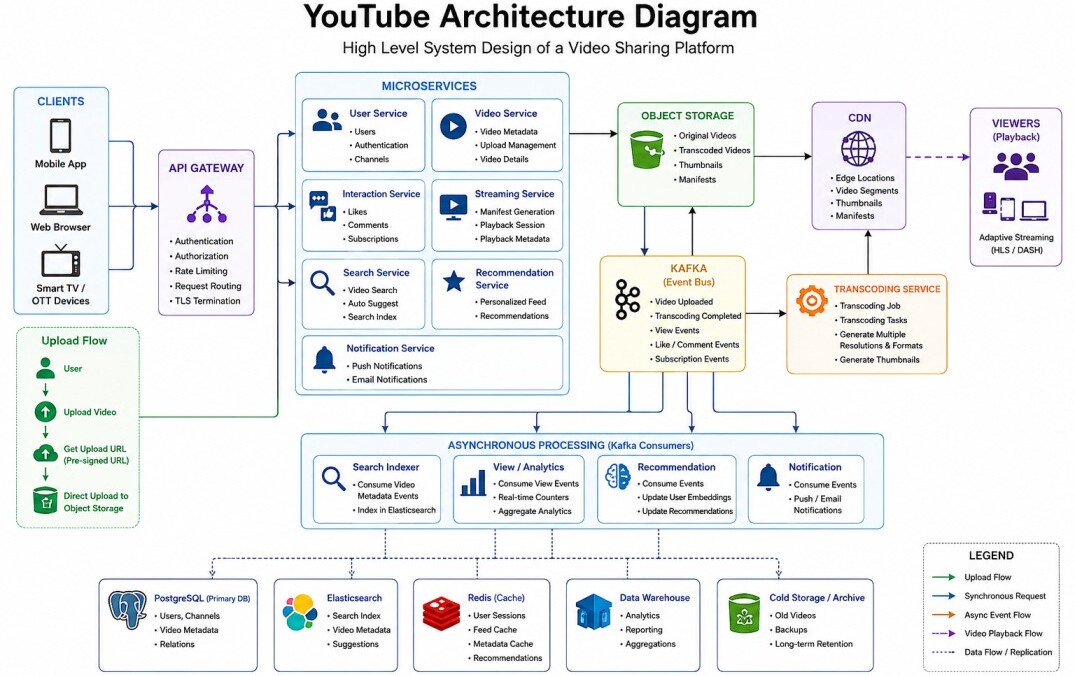
Core Services
User Service
The User Service manages users, channels, authentication information, subscriptions, and user-related data.User
USERS
--------------------------------------------------------------------------------
user_id | username | email              | status  | created_at
--------------------------------------------------------------------------------
U101    | amit     | amit@example.com    | ACTIVE  | 2026-01-10
U205    | rahul    | rahul@example.com   | ACTIVE  | 2026-02-15
Authentication
USER_AUTH
--------------------------------------------------------------------------------
auth_id | user_id | auth_provider | provider_user_id | password_hash | created_at
--------------------------------------------------------------------------------
A1001   | U101    | LOCAL         | NULL             | HASH_...      | 2026-01-10
A1002   | U205    | GOOGLE        | G123456          | NULL          | 2026-02-15
A1003   | U310    | LOCAL         | NULL             | HASH_...      | 2026-03-21
Channel
CHANNEL
--------------------------------------------------------------------------------
channel_id | user_id | name              | description       | status | created_at
--------------------------------------------------------------------------------
C101       | U101    | Tech With Amit    | Technology videos | ACTIVE | 2026-01-12
C205       | U205    | System Design     | System design     | ACTIVE | 2026-02-20
Subscription
SUBSCRIPTION
---------------------------------------------------------------------------
user_id | channel_id | status  | subscribed_at
---------------------------------------------------------------------------
U101    | C205       | ACTIVE  | 2026-04-01
U101    | C310       | ACTIVE  | 2026-04-05
Video Service
The Video Service manages video metadata and the video lifecycle.It creates video records, generates temporary upload credentials, tracks processing status, stores references to video objects, and exposes video metadata and playback information.
The actual video files are stored in Object Storage. The relational database stores only metadata and references to those objects.
Video
VIDEO
------------------------------------------------------------------------------------------------
video_id | channel_id | title                | description | duration | status      | upload_time
------------------------------------------------------------------------------------------------
V101     | C101       | System Design Basics | ...         | 720      | READY       | 10:00
V102     | C205       | Kafka Deep Dive      | ...         | 960      | READY       | 10:15
V103     | C310       | Java Concurrency     | ...         | 840      | PROCESSING  | 10:30
Video Asset
VIDEO_ASSET
------------------------------------------------------------------------------------------------
asset_id | video_id | resolution | codec | bitrate | object_key                         | status
------------------------------------------------------------------------------------------------
A1001    | V101     | 360p       | H264  | 800     | videos/V101/360p/video.m3u8       | READY
A1002    | V101     | 720p       | H264  | 2500    | videos/V101/720p/video.m3u8       | READY
A1003    | V101     | 1080p      | H264  | 5000    | videos/V101/1080p/video.m3u8      | READY
A1004    | V101     | 4K         | H265  | 15000   | videos/V101/4k/video.m3u8         | READY
Transcoding Service
The Transcoding Service processes uploaded videos asynchronously.It consumes upload events from Kafka, converts the original video into multiple resolutions and formats, generates thumbnails, and stores the resulting files in Object Storage.
Transcoding Job
TRANSCODING_JOB
------------------------------------------------------------------------------------------------
job_id  | video_id | input_object_key             | status      | retry_count | created_at
------------------------------------------------------------------------------------------------
J1001   | V101     | videos/V101/original.mp4     | COMPLETED   | 0           | 10:02
J1002   | V102     | videos/V102/original.mp4     | COMPLETED   | 1           | 10:17
J1003   | V103     | videos/V103/original.mp4     | PROCESSING  | 0           | 10:32
Transcoding Task
TRANSCODING_TASK
----------------------------------------------------------------------------------------------------
task_id | job_id | video_id | resolution | codec | status      | output_object_key
----------------------------------------------------------------------------------------------------
T1001   | J1001  | V101     | 360p       | H264  | COMPLETED   | videos/V101/360p/video.mp4
T1002   | J1001  | V101     | 720p       | H264  | COMPLETED   | videos/V101/720p/video.mp4
T1003   | J1001  | V101     | 1080p      | H264  | COMPLETED   | videos/V101/1080p/video.mp4
T1004   | J1001  | V101     | 4K         | H265  | PROCESSING  | videos/V101/4k/video.mp4
Streaming Service
The Streaming Service manages video playback metadata and returns the appropriate video manifest to the client.It does not serve video bytes directly. Video segments are stored in Object Storage and delivered to viewers through the CDN.
Video Manifest
VIDEO_MANIFEST
----------------------------------------------------------------------------------------------
manifest_id | video_id | type | object_key                         | status | created_at
----------------------------------------------------------------------------------------------
M1001       | V101     | HLS  | videos/V101/manifest.m3u8          | READY  | 10:20
M1002       | V102     | HLS  | videos/V102/manifest.m3u8          | READY  | 10:35
M1003       | V103     | HLS  | videos/V103/manifest.m3u8          | READY  | 10:50
Video Stream
VIDEO_STREAM
------------------------------------------------------------------------------------------------
stream_id | video_id | resolution | codec | bitrate | object_prefix              | status
------------------------------------------------------------------------------------------------
S1001     | V101     | 360p       | H264  | 800     | videos/V101/360p/          | READY
S1002     | V101     | 720p       | H264  | 2500    | videos/V101/720p/          | READY
S1003     | V101     | 1080p      | H264  | 5000    | videos/V101/1080p/         | READY
S1004     | V101     | 4K         | H265  | 15000   | videos/V101/4k/            | READY
If bandwidth decreases, the player can switch to a lower resolution to avoid buffering. When bandwidth improves, it can switch back to a higher resolution.
Other Services
The Search Service indexes video metadata such as titles, descriptions, tags, and channel information in Elasticsearch. Search indexing is asynchronous and does not block video uploads.The Recommendation Service processes watch history, likes, subscriptions, and other activity to generate personalized recommendations. Results can be precomputed and cached in Redis for low-latency retrieval.
The Interaction Service manages likes and comments. These operations are persisted separately from video files and can publish events for downstream processing.
The View and Analytics Service processes video-view events asynchronously.
Instead of synchronously updating the primary database for every view, view events are published to Kafka and processed by view-counting and analytics consumers.
Notification Service consumes events from Kafka and sends notifications when subscribed channels publish new videos or when other notification-generating activities occur.
Non-Functional Requirements
Low Latency
Low latency is achieved by keeping frequently accessed metadata and recommendations in Redis, using Elasticsearch for fast video search, and serving video segments from nearby CDN edge locations.The application services return playback metadata and manifests, while the CDN handles the actual video delivery.
High Availability
High availability is achieved by running multiple instances of stateless services behind a Load Balancer.Object Storage, Kafka, Redis, and the relational database use replication and failover mechanisms.
If one service instance or infrastructure component fails, another instance can continue serving requests.
Horizontal Scalability
Application services such as the Video Service, Search Service, Streaming Service, and Recommendation Service are stateless and can be scaled horizontally by adding more instances.Kafka distributes asynchronous workloads across multiple consumers, while transcoding workers can be increased independently based on video-processing demand.
High Throughput
High throughput is achieved by avoiding synchronous processing for expensive and high-volume operations.Video transcoding, search indexing, recommendations, view counting, analytics, and notifications are processed asynchronously through Kafka.
This keeps the synchronous API path lightweight and allows each workload to scale independently.
Fault Tolerance
The architecture isolates failures between services. If a transcoding worker fails, the job can be retried. If a Kafka consumer fails, events can be processed again after recovery.If Elasticsearch is unavailable, video uploads can continue because indexing is asynchronous.
If Redis becomes unavailable, the system can fall back to the underlying database with increased latency.
Global Video Delivery
Global video delivery is achieved through a distributed CDN. Frequently requested video segments are cached at edge locations close to users.This significantly reduces latency and prevents the application servers and origin storage from handling every video request.
Conclusion
A YouTube-like platform requires scalable storage, processing, and global delivery.Object Storage stores videos, Kafka handles asynchronous processing, and the CDN delivers video content with low latency.
Redis improves frequently accessed data, while Elasticsearch provides scalable search.
Stateless services, replication, retries, and independent scaling provide high availability, fault tolerance, and high throughput.