- Do we want the most accurate answer, or the fastest one?
- Do we continue operating during partial failure, or do we halt critical actions to preserve correctness?
This broader perspective is captured by the PACELC Theorem.
What is PACELC?
PACELC Theorem expands the CAP theorem by expressing what happens not only during network partitions (P) but also else (E) — when the system is working normally.In short: If a network Partition occurs (P), choose between Availability (A) and Consistency (C); Else (E), choose between Latency (L) and Consistency (C).
In simpler terms:
- During failure, you choose Availability or Consistency.
- During normal operation, you choose Latency or Consistency.
This means consistency comes at a cost both under failure and under perfect health. Even with no outages, we may be sacrificing performance to replicate data synchronously across regions.
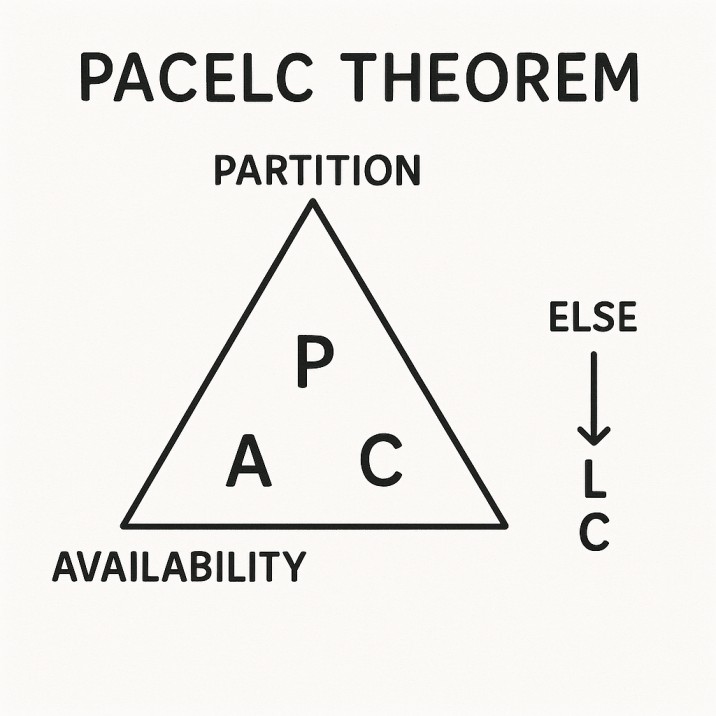
PACELC helps engineers decide when to return slightly stale data for speed and when to block until data is consistent.
Example: Product Search vs Inventory Checkout
Product Search (PA/EL Choice)
Searching items across categories must be extremely fast. Users browse repeatedly, often without buying.Systems like DynamoDB, Elasticsearch, Cassandra often choose high Availability during failure and prioritize low Latency during normal operation.
In PACELC terms, they behave like: PA / EL → Prioritize "Availability during Partition", Else prioritize "low Latency over Consistency"
So when you search for "running shoes," the system responds instantly, even if some data is slightly stale. Showing "200 items" instead of "198 items" doesn't hurt the business.
Inventory Checkout (PC/EC Choice)
Inventory for checkout must be strictly accurate. Overselling 100 shoes when only 20 remain leads to cancellations, refund operations, customer loss, and logistical failures.The system must prioritize Consistency during partition and Consistency during normal operation, even if it slows some requests.
In PACELC terms, they behave like: PC / EC → Prioritize "Consistency during Partition"; Else prioritize "Consistency over low Latency"
This is why checkout might occasionally show: "Sorry, this item just went out of stock." The system chooses correctness over speed, even when everything is working normally.
Summary
Even with no failures, we still choose between low latency and consistency. This is the core idea PACELC adds to CAP.Fast catalog browsing, quick recommendations, and low-friction search need speed. Accurate checkout, unique coupon redemption, and secure payments need consistency.