Despite the name, servers still exist. The difference is that developers do not provision or manage them. Compute resources are automatically allocated when requests arrive and released when they are no longer needed.
Serverless applications are commonly built using AWS Lambda, Azure Functions, or Google Cloud Functions, and are often integrated with services such as API Gateway, S3, DynamoDB, and SQS.
Why Do We Need Serverless Architecture?
Traditional Spring Boot applications require provisioning and managing virtual machines or containers, configuring infrastructure, scaling application instances, and applying operating system updates.These resources continue running even during periods of little or no traffic, increasing infrastructure costs.
With Serverless Architecture, compute resources are provisioned only when requests arrive and automatically released after execution completes.
As a result, applications scale automatically and you typically pay only for the compute time actually consumed.
How Serverless Works?
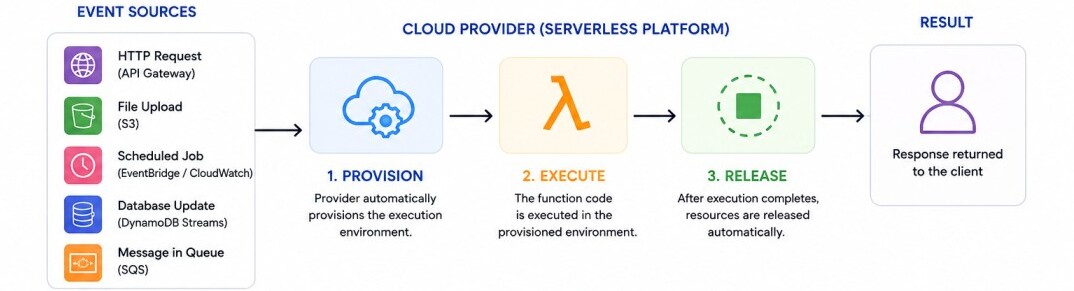
A serverless function executes in response to an event.Events can originate from an HTTP request, a file upload, a scheduled job, a database update, or a message arriving on a queue.
When an event occurs, the cloud provider automatically provisions the execution environment, runs the function, and releases the compute resources after execution completes.
The application scales automatically by creating additional function instances as request volume increases.
AWS Lambda Example
Suppose an application exposes an API for retrieving product information.GET /products/100
A simple Lambda function looks like this:
public class ProductHandler implements
        RequestHandler<APIGatewayProxyRequestEvent,
                       APIGatewayProxyResponseEvent> {

    @Override
    public APIGatewayProxyResponseEvent handleRequest(
            APIGatewayProxyRequestEvent request,
            Context context
    ) {
        return new APIGatewayProxyResponseEvent()
                .withStatusCode(200)
                .withBody("Product Details");
    }
}
Once execution completes, the compute resources are automatically released until the next event arrives.
Event Sources
Serverless functions can be triggered by many different AWS services.| Event Source | Typical Use Case | Example |
|---|---|---|
| API Gateway | REST APIs | Process HTTP requests from web or mobile clients |
| Amazon S3 | File upload processing | Generate thumbnails or process uploaded documents |
| Amazon SQS | Asynchronous message processing | Process background jobs from a message queue |
| Amazon EventBridge | Scheduled jobs and event routing | Run scheduled tasks or react to AWS service events |
| DynamoDB Streams | Reacting to database changes | Trigger processing when items are inserted or updated |
Automatic Scaling
One of the biggest advantages of Serverless Architecture is automatic scaling.Suppose a REST API normally receives one hundred requests per minute but suddenly experiences ten thousand requests during a flash sale.
AWS automatically creates additional Lambda execution environments to handle the increased workload without requiring manual intervention.
        Normal Traffic
              |
         API Gateway
              |
              v
           Lambda
         High Traffic
              |
         API Gateway
              |
     +--------+--------+
     |        |        |
     v        v        v
  Lambda   Lambda   Lambda
Stateless Execution
Serverless functions should be stateless.
A Lambda execution environment may be reused for multiple requests, but applications should never assume that local memory or temporary files will be available for future invocations.
Application state should instead be stored in external services such as DynamoDB, Amazon RDS, Redis, or S3.
Spring Boot and AWS Lambda
Although Spring Boot applications can be deployed as Lambda functions, a complete Spring Boot application typically has a larger startup time than a lightweight Java Lambda function.For small APIs, using a lightweight Lambda handler is often sufficient.
For enterprise applications that already use Spring Boot, the Spring Cloud Function project simplifies running Spring-based functions on AWS Lambda.
@Bean
public Function<String, String> uppercase() {
    return value -> value.toUpperCase();
}
Advantages
1. Serverless Architecture eliminates infrastructure management, allowing developers to focus on business logic instead of provisioning and maintaining servers.2. Applications automatically scale based on demand, and organizations pay only for the compute time actually consumed. This makes serverless particularly attractive for workloads with unpredictable or highly variable traffic.
3. Since cloud providers manage operating systems, patching, and high availability, operational overhead is significantly reduced.
Limitations
1. Serverless functions are generally best suited for short-running tasks. Long-running computations may exceed execution limits or become more expensive than running dedicated servers.2. Cold starts can introduce additional latency, especially for Java applications. Applications also become more dependent on cloud-provider-specific services, increasing the possibility of vendor lock-in.
3. Debugging distributed serverless applications may require centralized logging, distributed tracing, and careful monitoring because application logic is spread across many independent functions.
Summary
Serverless Architecture enables developers to build applications without managing the underlying infrastructure. The cloud provider automatically provisions compute resources, scales applications, and charges only for the compute time consumed.Services such as AWS Lambda, API Gateway, S3, DynamoDB, and SQS are commonly used to build scalable, event-driven applications.
Although Serverless Architecture simplifies deployment and operations, it also introduces considerations such as cold starts, execution limits, and vendor lock-in.
It is best suited for event-driven workloads and applications with variable or unpredictable traffic.