Yet, as systems scale across devices, networks, and regions, the simple request–response model becomes an expansive discipline in distributed engineering.
What Is Client–Server Architecture?
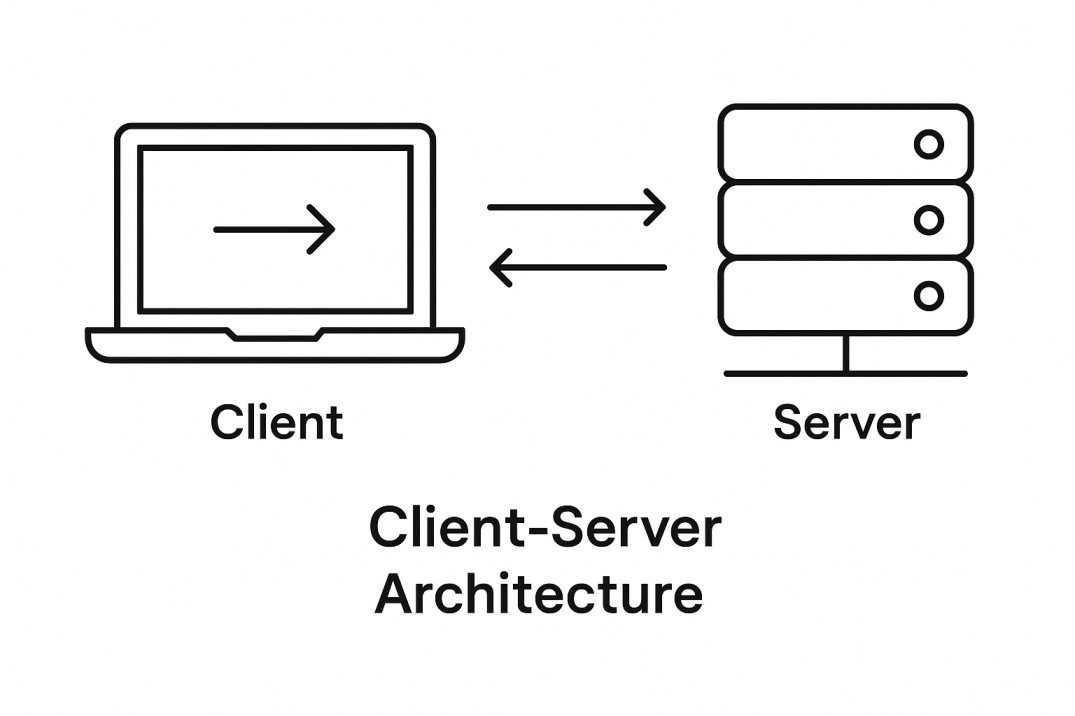
At its simplest, Client–Server Architecture describes a model where a client (browser, mobile app, IoT device) requests a service, and a server processes the request and returns a response.They communicate over a network using standardized protocols like HTTP(S), TCP/IP, WebSockets, or application-specific interfaces.
Role of Clients
The client could be a web browser, Android/iOS app, smartwatch, or even voice assistant. The client's primary responsibility is to provide a seamless user interface, handle interactions smoothly, and send requests efficiently to the backend.A client should never handle business logic such as discount validation or inventory reservation. Doing so would expose business rules to tampering and would create inconsistent behavior across devices.
Instead, the client focuses on:
- rendering product listings,
- managing in-session cart state,
- sending user actions to backend services,
- integrating with local storage or cookie state for responsiveness.
The server remains the single source of truth.
Role of Servers
The server encompasses everything from API gateways to microservices, databases, and background systems. In a large software system, requests flow as follows:Mobile/Web Client → API Gateway → Microservices → Caches → Databases → Async Messaging → Search/ML Systems
The server doesn't simply compute and respond. It enforces authentication, authorization, business validation, inventory checks, price consistency, payment orchestration, and data durability.
A shopping cart update triggers cache writes, Kafka messages, inventory locks, price rule evaluation, and analytics pipelines. The backend is far more than a responder—it is the business.
Example: Placing an Order
When a user clicks "Buy Now" on a product, here is the flow in a deep client–server architecture:1. The client sends a checkout request with user, address, payment preference, and cart payload.
2. The API Gateway validates identity and routes the request to the Order Service.
3. The Order Service calls the Inventory Service to reserve stock.
4. It calls the Pricing/Promotion Service to validate discounts.
5. It orchestrates with the Payment Service for charge authorization.
5. After success, the order is persisted to a distributed database, and events are published to Kafka/SQS.
6. Finally, the server returns a successful order response to the client.
The client only sees a spinner followed by "Order Placed!"—but the server executed a multi-component distributed workflow.
Stateless Clients, Stateful Systems
A fundamental design principle in client-server architecture is to keep clients as stateless as possible while allowing the server to own and manage application state.Clients should contain only temporary state needed for rendering the user interface, while the server remains the single source of truth.
State stored on the client, such as shopping cart items, authentication tokens, or user preferences, must always be synchronized with the server to ensure consistency across devices and sessions.
Keeping clients stateless enables horizontal scaling, since requests can be routed to any healthy server instance without relying on local session data.
It also improves fault tolerance by allowing failed servers to be replaced without losing user sessions and simplifies load balancing across multiple service instances.
Behind the scenes, the backend maintains application state using distributed databases, distributed caches, and replicated storage.
This ensures that a user can seamlessly switch from a laptop to a phone, or continue using the application after a server failure, without losing their session or data.
Security and Trust Boundaries
Clients are untrusted by default. The server must assume a client can be modified, rooted, or tampered with. All business validation, inventory locking, and payment authorization must be enforced server-side.A rule like "25% off on first purchase" cannot be trusted if executed on the device. The server is the guardian of:
- pricing integrity,
- identity/authentication,
- transaction validity,
- fraud prevention.
Client-side validation only improves UX; it never replaces backend enforcement.
Conclusion
Client-Server Architecture is much more than a simple request-response model.It defines how responsibilities are divided between clients and servers, establishes clear trust boundaries, and provides the foundation for building scalable, secure, and resilient distributed systems.
Even as applications evolve into hundreds of microservices across multiple regions, the core principle remains the same: clients request services, and servers enforce business rules and maintain data integrity.