These two communication styles are known as synchronous and asynchronous communication. Choosing the right approach has a significant impact on a system's performance, scalability, availability, and fault tolerance.
What Is Synchronous Communication?
Synchronous Communication is when the caller waits for the callee to finish processing and return a response. This is how regular HTTP or gRPC unary calls work, the consumer sends a request and blocks until the server responds.In synchronous systems, calls form a chain. If Service A calls Service B, and B calls Service C, the entire user request remains blocked until all dependencies respond.
This model is simple and intuitive because it mirrors a function call inside a single application. However, synchronous communication can introduce tight coupling between services.
If one service slows down or fails, the entire call chain can degrade.
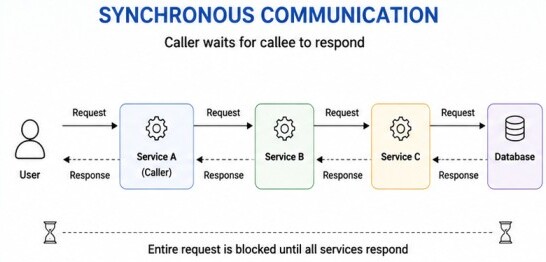
Example: Checkout Price Calculation
When a user tries to place an order, the Order Service must call several other services synchronously:-The Pricing Service to get the final price after discounts.
-The Inventory Service to confirm stock.
-The Tax Service for tax computation.
-The Payment Gateway for authorization.
Each call must succeed and return immediately; otherwise, checkout fails. This is a classic use case where synchronous communication provides predictable correctness. The user expects an instant Yes/No answer.
Internally, these calls may use REST or gRPC, both synchronous patterns.
Where to use Synchronous Communication?
While async systems are more flexible, synchronous calls are still required in places where the caller must immediately know the result. Examples include:- Checking stock availability in real time,
- Validating coupon eligibility,
- Verifying payment authorization,
- Generating OTPs for login,
- Fetching user profile details.
These interactions must respond instantly. Accuracy and consistency matter more than decoupling.
What Is Asynchronous Communication?
Asynchronous Communication means the caller does not wait for the callee to finish work. Instead, it sends a message or event, and the receiver processes it independently.Systems like Kafka, RabbitMQ, AWS SQS, AWS EventBridge, and Apache Pulsar are designed for this pattern.
Async communication promotes loose coupling. Services do not need to be online at the same time. Workloads can be buffered, retried, replayed, and processed at the pace of consumers.
As a result, asynchronous systems scale more efficiently and handle spikes gracefully.
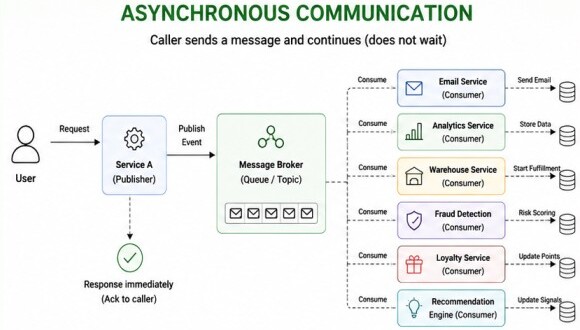
Example: Order Confirmation, Analytics & Email Notifications
After an order is successfully placed, multiple downstream processes are needed:- Sending confirmation emails,
- Updating the analytics pipeline,
- Notifying the recommendation engine,
- Updating loyalty points.
Doing all these synchronously would slow down the user experience drastically. Instead, the Order Service publishes an event like:
ORDER_PLACED { orderId: "A123", userId: "U555", amount: 1999.0 }
Where to use Asynchronous Communication?
Async systems excel in high-volume workloads where tasks happen after the main user flow. Typical examples include:- Order lifecycle notifications,
- Search index updates,
- Fraud model scoring,
- Inventory replenishment events.
These processes do not block the user and can tolerate delays. They also scale better during seasonal spikes like Diwali sales or Black Friday.
Conclusion
A scalable architecture is not synchronous or asynchronous—it is both. The art lies in choosing the right interaction style for the right part of the business flow.Synchronous calls deliver correctness and immediate feedback. Asynchronous flows deliver resilience, scalability, and low cost.