With the introduction of SQLAlchemy 2.x, the library adopted a cleaner, more explicit API while providing first-class support for asynchronous database programming through AsyncSession.
In this article, we will build a complete understanding of SQLAlchemy 2.x and AsyncSession by creating a data access layer that integrates seamlessly with FastAPI.
SQLAlchemy is responsible for bridging the gap between Python objects and relational database tables, allowing developers to work with Python models instead of writing SQL for every operation.
The Problem SQLAlchemy Solves
Suppose we want to retrieve all users from a database. Without an ORM, we might write something like:connection.execute(
"SELECT * FROM users"
)
This repetitive code quickly becomes difficult to maintain.
Instead of working directly with SQL, it is preferable to work with Python objects. Instead of writing:
SELECT *
FROM users
WHERE id = 1;
user = await session.get(User, 1)
SQLAlchemy Architecture
Although FastAPI endpoints typically interact only with AsyncSession, several components work behind the scenes to execute every database operation.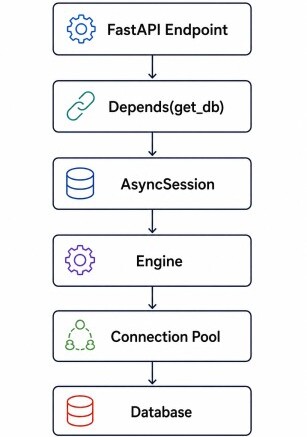
get_db() dependency and injects an AsyncSession into the endpoint.
The endpoint performs ORM operations using this session without worrying about how database connections are created or managed.
The AsyncSession represents a unit of work. It tracks ORM objects, manages transactions, executes SQL statements, and coordinates communication with the database.
Whenever the session needs to execute a query, it requests a database connection from the Engine.
The Engine is the core of SQLAlchemy. It manages database communication, understands the database dialect (PostgreSQL, MySQL, SQLite, etc.), and maintains the application's connection pool.
Instead of creating a new database connection for every request, the Engine reuses existing connections by borrowing one from the pool whenever possible.
The Connection Pool maintains a collection of reusable database connections.
Once a query finishes executing, the connection is returned to the pool instead of being closed, making it immediately available for future requests.
Installing SQLAlchemy
Install SQLAlchemy along with the asynchronous PostgreSQL driver.pip install sqlalchemy asyncpgpip install aiosqlitefrom sqlalchemy.ext.asyncio import create_async_engine
DATABASE_URL = (
"postgresql+asyncpg://user:password@localhost/demo"
)
engine = create_async_engine(
DATABASE_URL,
echo=True
)
Setting
echo=True instructs SQLAlchemy to log every SQL statement, which is useful during development.
Creating AsyncSession
Applications usually do not instantiateAsyncSession directly. Instead, SQLAlchemy provides async_sessionmaker to create and configure AsyncSession instances.
from sqlalchemy.ext.asyncio import (
    AsyncSession,
    async_sessionmaker
)

SessionLocal = async_sessionmaker(
    bind=engine,
    class_=AsyncSession,
    expire_on_commit=False
)
Creating sessions through async_sessionmaker ensures that every request receives its own isolated AsyncSession.
Creating Your First Model
Suppose our application manages users. A model might look like this.from sqlalchemy.orm import DeclarativeBase
from sqlalchemy.orm import Mapped
from sqlalchemy.orm import mapped_column
class Base(DeclarativeBase):
pass
class User(Base):
__tablename__ = "users"
id: Mapped[int] = mapped_column(
primary_key=True
)
name: Mapped[str]
email: Mapped[str]
Creating Database Tables
Once the models have been defined, SQLAlchemy can create the database schema.async with engine.begin() as conn:
await conn.run_sync(
Base.metadata.create_all
)
Injecting AsyncSession into FastAPI
One of the biggest advantages of FastAPI is its Dependency Injection system. We can inject an AsyncSession into every endpoint.async def get_db():
async with SessionLocal() as session:
yield session
from fastapi import Depends

@app.get("/users")
async def get_users(
    db: AsyncSession = Depends(get_db)
):
    ...
The endpoint never needs to worry about opening or closing database connections.
CRUD Operations
Now that we have an AsyncSession injected into our endpoint, we can perform the four basic CRUD operations.Creating Records
Let's create a new user.@app.post("/users")
async def create_user(
db: AsyncSession = Depends(get_db)
):
user = User(
name="John",
email="john@example.com"
)
db.add(user)
await db.commit()
await db.refresh(user)
return user
User object is created. The object is added to the session using add().
Calling
commit() persists the changes to the database, while refresh() reloads the object so that database-generated values, such as the primary key, become available.
Reading Records
Fetching data uses the SQLAlchemy 2.xselect() API.
from sqlalchemy import select

@app.get("/users")
async def get_users(
    db: AsyncSession = Depends(get_db)
):
    result = await db.execute(
        select(User)
    )
    users = result.scalars().all()
    return users
User objects.
Updating Records
Updating a record begins by retrieving the existing entity from the database.After modifying one or more attributes, committing the transaction automatically generates the appropriate
UPDATE statement.
@app.put("/users/{user_id}")
async def update_user(
    user_id: int,
    db: AsyncSession = Depends(get_db)
):
    user = await db.get(User, user_id)
    if user is None:
        return {"message": "User not found"}

    user.name = "Alice"
    user.email = "alice@example.com"

    await db.commit()
    await db.refresh(user)

    return user
commit() is called, it detects the modified fields and generates the appropriate UPDATE statement.
Deleting Records
Deleting follows a similar pattern. The entity is first loaded into the session and then marked for deletion.@app.delete("/users/{user_id}")
async def delete_user(
user_id: int,
db: AsyncSession = Depends(get_db)
):
user = await db.get(User, user_id)
if user is None:
return {"message": "User not found"}
await db.delete(user)
await db.commit()
return {
"message": "User deleted successfully"
}
delete() is called, SQLAlchemy marks the entity for deletion.
The corresponding
DELETE statement is executed only after the transaction is committed. Once the commit succeeds, the row is permanently removed from the database.
The Lifecycle of AsyncSession
For every incoming request, a newAsyncSession is created.
The AsyncSession exists only for the lifetime of a single request. After the response is returned, FastAPI automatically cleans up the session.
A production application should never share the same AsyncSession across multiple requests. Every request should receive its own session instance.One common mistake is creating a session manually inside every endpoint.
session = AsyncSession(...)
Another common mistake is forgetting to commit transactions after modifying data. Without calling
commit(), changes remain only inside the session and are never persisted to the database.
Conclusion
SQLAlchemy 2.x and AsyncSession provide the foundation for building asynchronous, production-grade FastAPI applications.Together, they simplify database access, transaction management, and object-relational mapping while integrating seamlessly with FastAPI's Dependency Injection system.
In the next article, we will build on this foundation by exploring transactions, relationship mapping, lazy loading, eager loading, connection pooling, and performance optimization techniques that are essential for large-scale production systems.
