While microservices improve scalability and team autonomy, they introduce a new challenge: communication between services.
Many organizations initially use synchronous REST APIs for communication. While this approach is easy to understand, it often creates tight coupling, cascading failures, scalability bottlenecks, and operational complexity. As systems grow, teams begin adopting Event-Driven Architecture (EDA), where services communicate through events rather than direct API calls.
Apache Kafka has become one of the most popular platforms for implementing event-driven microservices. Companies such as Netflix, Uber, LinkedIn, Airbnb, and Amazon use event-driven architectures extensively to build highly scalable distributed systems.
In this article, we will explore how Kafka enables event-driven microservices, examine common architecture patterns, discuss real-world use cases, and understand the trade-offs involved in designing distributed systems around events.
Problem with Synchronous Microservice Communication
Consider a simple e-commerce application. When an order is placed, several business processes must occur.
- The order must be saved.
- Inventory must be reserved.
- Payment must be processed.
- Confirmation emails must be sent.
- Analytics systems must be updated.
Many teams initially implement this using REST APIs.
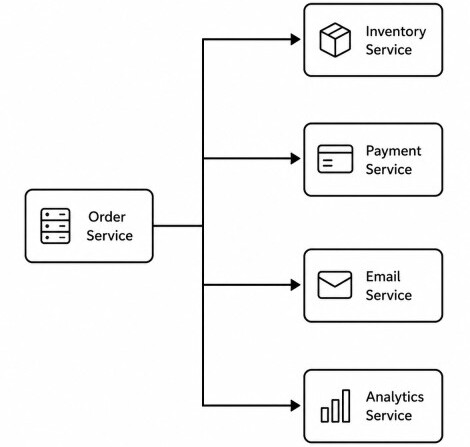
1. If Payment Service is unavailable, order creation fails.
2. If Email Service becomes slow, customer response times increase.
3. Adding a new downstream system requires changes to Order Service.
4. The Order Service becomes tightly coupled to every downstream dependency.
5. This architecture becomes increasingly difficult to scale and maintain.
Introducing Event-Driven Architecture
Event-Driven Architecture changes the communication model. Instead of directly calling other services, a service publishes an event describing something that happened.Example:
- Order Created
- Payment Completed
- Inventory Reserved
- Shipment Created Other services subscribe to these events and react independently. The architecture becomes:
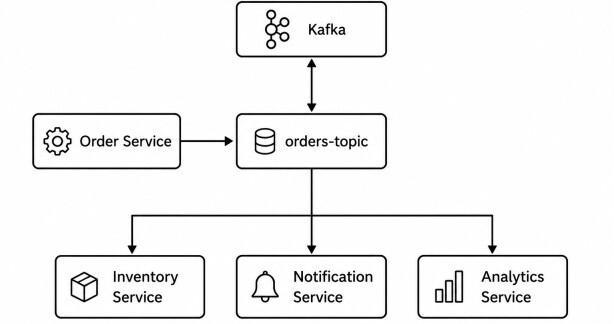
What are Domain Events?
An event represents something that has already happened.Examples include:
- Order Created
- Order Cancelled
- Payment Completed
- Customer Registered
- Product Updated Events should represent business facts rather than commands.
Good event: Order Created Poor event: Create Inventory Record
Events describe outcomes. Consumers decide how to react. This distinction is fundamental to event-driven design.
Example Order Processing Flow
Consider an online marketplace. A customer places an order. The Order Service publishes:{
"eventType": "ORDER_CREATED",
"orderId": 1001,
"customerId": 500,
"amount": 2500
}
Kafka
   |
   +----→ Inventory Service
   |
   +----→ Payment Service
   |
   +----→ Notification Service
   |
   +----→ Analytics Service
Event Notification Pattern
The simplest event-driven pattern is the Event Notification Pattern. A service publishes an event indicating that something occurred. Example:{
"orderId": 1001,
"eventType": "ORDER_CREATED"
}
Order Service
      ↓
ORDER_CREATED
      ↓
Inventory Service
      ↓
GET /orders/1001
Event-Carried State Transfer Pattern
A more common Kafka pattern is Event-Carried State Transfer. Instead of publishing only an identifier, the event includes required business data. Example:{
"orderId": 1001,
"customerId": 500,
"amount": 2500,
"items": [
{
"productId": 10,
"quantity": 2
}
]
}
1. Reduced API Calls
2. Lower Latency
3. Better Scalability
4. Higher Availability
This is often the preferred approach in large Kafka-based systems.
The Publish-Subscribe Pattern
Kafka naturally supports the Publish-Subscribe Pattern. One producer publishes events. Multiple independent consumers receive them. Example: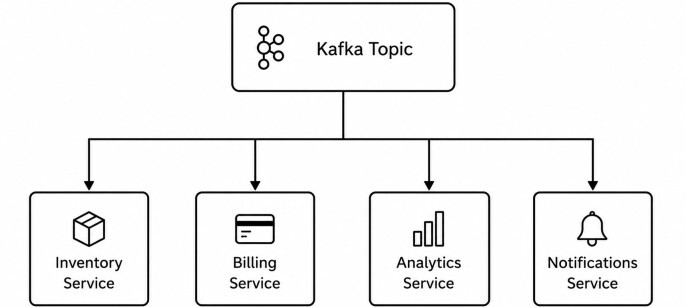
The Competing Consumers Pattern
Some workloads require increased processing throughput. Kafka achieves this using consumer groups. Example:payment-processing-group
Consumer-1
Consumer-2
Consumer-3
Consumer-4
Partition-0 → Consumer-1
Partition-1 → Consumer-2
Partition-2 → Consumer-3
Partition-3 → Consumer-4
The Saga Pattern
One of the most important patterns in distributed systems is the Saga Pattern. Consider order placement. Several services participate:- Order Service
- Payment Service
- Inventory Service
- Shipping Service
Traditional databases support transactions. Microservices do not. A distributed transaction across multiple services is difficult and expensive.
The Saga Pattern coordinates multiple local transactions through events. Example:
Order Created
       ↓
Inventory Reserved
       ↓
Payment Processed
       ↓
Shipment Created
Handling Failures in a Saga
Failures are inevitable. Suppose payment processing fails. The workflow becomes:Order Created
↓
Inventory Reserved
↓
Payment Failed
Release Inventory
       ↓
Cancel Order
       ↓
Notify Customer
The Outbox Pattern
One common challenge is ensuring database updates and Kafka events remain consistent. Consider:Save Order
↓
Publish Event
- The order exists.
- No event is published.
- Systems become inconsistent.
The Outbox Pattern solves this problem. The service writes both:
- Order Table
- Outbox Table
within a single database transaction. Example:
BEGIN

Insert Order
Insert Outbox Event

COMMIT
Maintaining Ordering in Event-Driven Systems
Ordering is often critical. Example:Order Created
↓
Payment Received
↓
Order Shipped
ProducerRecord<String, String> record =
    new ProducerRecord<>(
        "orders",
        orderId,
        eventJson
    );
Building Materialized Views
Many organizations use Kafka to create specialized read models. Example:- Orders Database
- Payments Database
- Inventory Database
A reporting service consumes events from all domains. It builds: Analytics Database, optimized for reporting. This pattern is common in CQRS architectures. Kafka acts as the integration layer connecting multiple bounded contexts.
Event Versioning Strategy
Events evolve over time.Version 1:
{
  "orderId": 1001
}
{
  "orderId": 1001,
  "customerId": 500
}
- Backward Compatible Changes
- Optional Fields
- Schema Registry
- Versioned Events
Ignoring event evolution often creates production problems.
When Not to Use Event-Driven Architecture
Event-driven systems introduce complexity. Not every interaction should be asynchronous. For example:Validate Login Credentials
↓
Check User Permissions
↓
Fetch Product Details
Choosing the correct communication model is an important architectural decision.
Common Kafka Architecture Interview Questions
Why Kafka is useful for microservices?- Kafka decouples producers and consumers, enabling independent scaling and deployment.
Saga Pattern
- Sagas coordinate distributed transactions through a sequence of events and compensating actions.
Outbox Pattern
- The Outbox Pattern ensures database updates and event publication remain consistent.
Event ordering
- Ordering is guaranteed only within a partition, which is why related events should use the same partition key.
Eventual consistency
- Event-driven systems typically sacrifice immediate consistency in exchange for scalability, resilience, and loose coupling.
Conclusion
Event-driven architecture is one of the most powerful ways to build scalable microservices systems. By using Kafka as the communication backbone, services become loosely coupled, independently deployable, and capable of scaling horizontally without creating chains of synchronous dependencies.Patterns such as Publish-Subscribe, Event-Carried State Transfer, Competing Consumers, Sagas, Outbox, and Materialized Views form the foundation of modern Kafka-based architectures. These patterns are widely used across large-scale production systems and frequently appear in system design interviews for senior engineers, architects, and technical leaders.